
Table of Contents
- What Counts as an Electrical Emergency
- Signs of Faulty Electrical Wiring You Should Not Ignore
- Troubleshooting Tripped Circuit Breakers Before You Call
- DIY Safety Assessment: What to Check While You Wait
- Emergency Electrical Services: Residential and Commercial
- What to Expect When You Call for Emergency Electrical Services
- Post-Emergency Maintenance: Preventing the Next Problem
- Frequently Asked Questions
Last Updated: August 29, 2026
Electrical emergencies don’t wait for a convenient time. A burning smell from an outlet, a breaker that won’t reset, or sudden power loss demands immediate attention, and the wrong response can make a dangerous situation worse. At Dead On Electrical Services, we respond to these calls regularly across the Las Vegas Valley. This guide covers what qualifies as an emergency, how to assess your situation safely, and what to expect from professional electrical services.
The Las Vegas climate adds complications. Extreme heat strains outdoor wiring, pool and spa equipment, and aging electrical panels. Homes built in the 1980s and 1990s throughout Henderson, Summerlin, and North Las Vegas often have panels never designed for modern electrical loads. Knowing what you’re dealing with is the first step toward handling it correctly.
What Counts as an Electrical Emergency
An electrical emergency is any situation where continued use of your electrical system creates immediate risk of fire, electrocution, or total power loss to critical equipment.
Clear emergencies include:
- A burning smell from an outlet, panel, or switch
- Visible sparking at an outlet or breaker panel
- A breaker that trips immediately every time you reset it
- Exposed or damaged wiring
- Complete loss of power to your home or large portion of it
- Any electrical problem near water, bathrooms, kitchens, or pool equipment
Non-emergencies needing prompt attention include outlets that stopped working, a single tripped breaker that resets and holds, or a ceiling fan that stopped functioning. Those are real problems, but they don’t require immediate service.
If you’re uncertain, treat it as an emergency. The cost of an unnecessary call is far lower than the cost of an electrical fire.
Signs of Faulty Electrical Wiring You Should Not Ignore
Faulty wiring rarely announces itself loudly. Most of the time it shows up as small, easy-to-dismiss symptoms that homeowners notice for weeks before something serious happens.
Burning Smells and Discolored Outlets
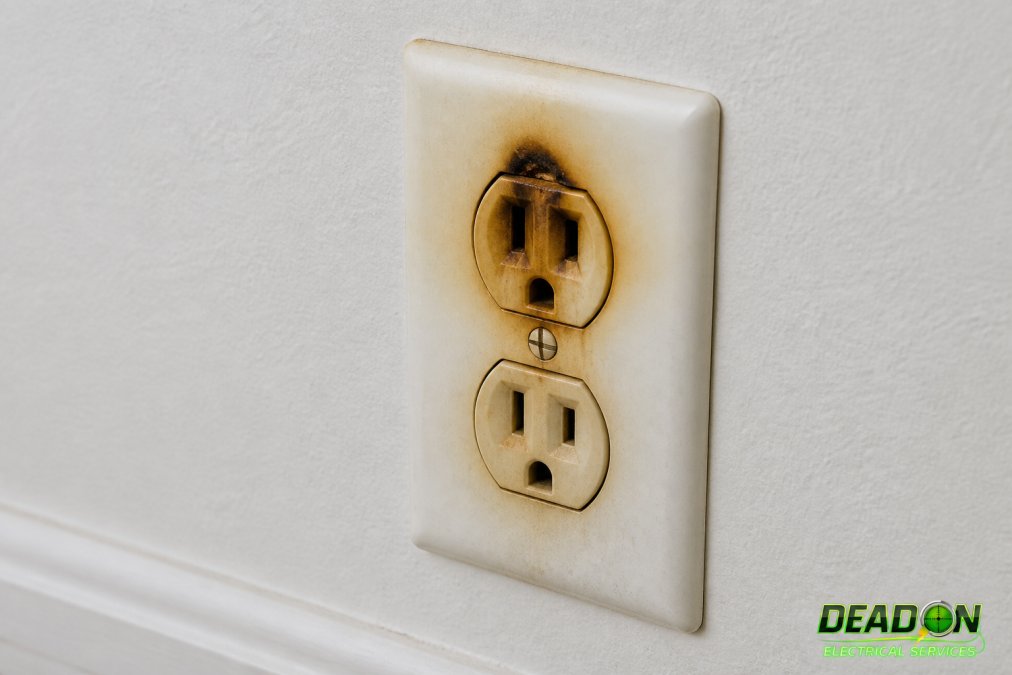
A burning smell near an outlet or switch is a clear sign of a wiring problem. The smell typically comes from insulation melting around a wire carrying more current than it should, or from a loose connection generating heat at the terminal. Stop using that outlet immediately.
Discoloration around an outlet face, yellowing, brown scorch marks, or blackening, tells the same story. That outlet needs replacement, along with a check of the wiring behind it.
According to the U.S. Fire Administration’s electrical fire data, electrical fires are among the leading causes of residential structure fires. Faulty wiring and overloaded circuits are consistently cited as primary contributing factors. In Las Vegas, where homes run air conditioning for six or more months a year, demand on older wiring is higher than most homeowners realize.
Flickering Lights and Voltage Fluctuations
Flickering lights are commonly dismissed as a bulb issue. Occasional dimming when a large appliance starts can be normal. But persistent flickering, especially across multiple rooms or repeated brightening and dimming without an obvious cause, can point to a loose connection, neutral problem, or issue with the electrical service or panel.
Voltage fluctuations, where lights visibly brighten and dim, often point to a loose neutral connection. This is serious. A floating neutral can send damaging voltage swings through your home’s circuits and damage electronics and appliances. It’s not something to troubleshoot yourself.
Troubleshooting Tripped Circuit Breakers Before You Call
A tripped breaker is the most common electrical call we receive, and homeowners can often handle it themselves. A breaker trips to protect the circuit from overload or a fault.
Here’s the practical process:
- Identify which breaker has tripped. It will be in a middle position or fully OFF.
- Before resetting it, unplug or turn off everything on that circuit.
- Push the breaker fully to OFF, then firmly back to ON.
- Gradually restore power to devices on that circuit, one at a time.
If the breaker holds, you likely had a temporary overload. Redistribute the load across circuits going forward.
When a Tripped Breaker Signals a Bigger Problem
A breaker that trips immediately upon reset, especially after loads on the circuit have been turned off or unplugged, usually indicates a fault or another problem that needs diagnosis. A short circuit, ground fault, damaged equipment, or even a failing breaker may be involved. The breaker is doing its job by shutting the circuit down when it detects an unsafe condition.
The same applies to a breaker that trips repeatedly over days or weeks under normal load. This often means the breaker itself is failing, or the circuit is carrying more load than it was designed for. In older Las Vegas homes, this frequently comes up when homeowners add large appliances, EV chargers, or additional HVAC equipment without a corresponding panel or circuit upgrade.
Don’t keep resetting a breaker that won’t hold. That’s the panel telling you something is wrong.
DIY Safety Assessment: What to Check While You Wait
Before a licensed electrician arrives, there are things you can safely check and things you should leave alone.
Safe to check yourself:
- Is there a burning smell near the panel, outlets, or switches?
- Are any outlets warm to the touch on the cover plate?
- Are any outlet covers discolored, cracked, or showing scorch marks?
- Is the breaker panel making buzzing, crackling, or humming sounds?
- Are lights flickering in more than one room?
- Is there visible damage to any wiring you can see?
- Is the area near any electrical issue free from water or moisture?
- Do you know the location of your main breaker shutoff?
Do not attempt yourself:
- Do not open the breaker panel cover or touch any wiring inside
- Do not attempt to repair or splice any wiring
- Do not reset a breaker more than once if it trips again immediately
- Do not use an outlet that is sparking, warm, or discolored
- Do not assume an outdoor circuit is safe after storm damage
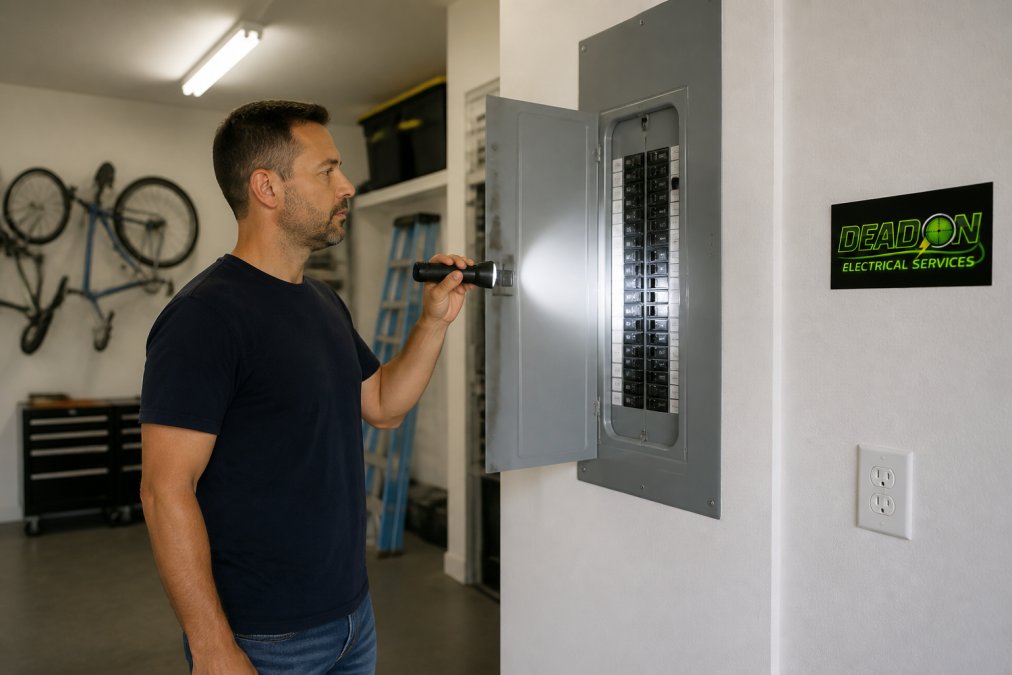
If you smell burning or see sparking, turn off the affected circuit or main breaker only if it is safe to do so. If the panel itself is sparking, smoking, or showing signs of fire, do not approach it. Move everyone to a safe location and call emergency services if there is an active fire, then contact a licensed electrician.
Emergency Electrical Services: Residential and Commercial
Dead On Electrical Services handles emergency electrical work for both residential and commercial properties throughout the Las Vegas Valley. Electrical hazards don’t improve on their own.
|
Emergency Type |
Common Cause |
What a Technician Does |
|---|---|---|
|
Breaker panel failure |
Age, overload, heat damage |
Diagnose fault, replace breakers or panel |
|
Sparking outlets |
Loose wiring, worn contacts |
Inspect circuit, replace outlet and wiring as needed |
|
Burning smell |
Overloaded circuit, arcing |
Locate source, isolate circuit, repair or replace |
|
GFCI won’t reset |
Ground fault, moisture, wiring fault |
Test circuit, replace GFCI, trace fault |
|
Power outage (partial) |
Tripped main, failed breaker, utility issue |
Isolate cause, restore power, repair as needed |
|
Outdoor electrical hazard |
Weather damage, worn conduit |
Inspect, repair, restore code compliance |
Panel Upgrades and Breaker Panel Failures
Breaker panel failure is common in the Las Vegas Valley. Panels from the 1980s and early 1990s, common in established neighborhoods across Henderson, Summerlin, and North Las Vegas, were typically rated for loads that don’t reflect how those homes are used today. Add a second HVAC unit, an EV charger, a hot tub, and modern appliances, and an older 100-amp panel runs well beyond its intended capacity.
Signs that a panel upgrade belongs on your list:
- Breakers that trip regularly under normal use
- A panel that runs warm or makes noise
- An older fuse panel with limited capacity, signs of deterioration, or no practical room for modern electrical loads
- No room to add circuits for new equipment
- Lights that dim noticeably when large appliances start
A panel upgrade is not an emergency repair in the traditional sense, but a panel that’s failing, buzzing, burning, or tripping under minimal load absolutely is. This is not a DIY project. Panel work involves live conductors at the utility connection point that cannot be de-energized without utility involvement.
GFCI, Arc Fault, and Outdoor Electrical Hazards
Ground fault circuit interrupters (GFCIs) are required by code in kitchens, bathrooms, garages, outdoor areas, and near pools and spas. A GFCI that won’t reset, trips immediately, or has stopped protecting its circuit is a genuine safety issue.
Arc fault circuit interrupters (AFCIs) protect against arcing faults in wiring that can ignite insulation without tripping a standard breaker. The Consumer Product Safety Commission’s guidance on arc fault protection recommends AFCI protection in bedrooms and living areas of homes where wiring has not been updated.
Outdoor electrical hazards are especially common in Las Vegas after summer monsoon storms. Conduit cracked from UV exposure, outlets that have taken on water, and pool equipment damaged by heat or moisture all require prompt inspection. Don’t assume outdoor wiring is fine after a storm just because nothing looks obviously wrong.
What to Expect When You Call for Emergency Electrical Services
When you call, be prepared to describe:
- What you’re seeing, smelling, or hearing
- Which part of the home or property is affected
- Whether you’ve already shut off any breakers or the main power
- Any recent changes, new appliances, recent work, or storm activity
A licensed electrician will arrive, assess the situation, and give you a clear explanation of what they found before any work begins. If the problem requires power to be shut off to part or all of the home, that will be explained upfront.
Dead On Electrical Services is licensed and insured, and has been serving the Las Vegas Valley since 2018.
What you should expect from any legitimate licensed contractor:
- Verification of their license upon request (Nevada State Contractors Board licenses are publicly searchable)
- A clear explanation of the problem and proposed repair before work starts
- Work performed to current NEC standards
- No pressure to approve additional work without clear explanation of why it’s needed
Post-Emergency Maintenance: Preventing the Next Problem
Most electrical emergencies have a history. A breaker that finally fails has usually been running hot for months. An outlet that sparks has likely had a loose connection for years. After an emergency repair, ask not just “is it fixed?” but “what else needs attention?”
Post-emergency steps worth taking:
Request a panel inspection. If the emergency involved a breaker failure, overloaded circuit, or burning smell from the panel, have the entire panel inspected while the electrician is on site. Identifying a second problem during the same visit costs far less than a return emergency call.
Check GFCI protection throughout the home. Test every GFCI outlet using the test/reset buttons. If any fail to trip or fail to reset, they need replacement. In Las Vegas homes with pools and spas, this is especially important.
Consider an electrical safety inspection. An inspection isn’t just for older homes. Any home that has had significant electrical problems, recent renovations done without permits, or equipment added beyond its original design load can benefit from a full assessment.
Document what was repaired. Keep a simple record of what was done, which circuits were involved, and when. This is useful for insurance purposes and for any future electrician who works on your home.
Electrical systems in Las Vegas work hard. The combination of high summer temperatures, heavy air conditioning loads, aging infrastructure in many neighborhoods, and rapid adoption of EVs and high-draw appliances puts real stress on residential wiring. Preventative attention after an emergency is the most practical way to avoid the next one.
Frequently Asked Questions
What qualifies as an electrical emergency in a residential home?
A residential electrical emergency is any situation that poses an immediate risk of fire, shock, or total power loss. That includes sparking outlets, a burning smell near your panel or walls, exposed wiring, a breaker that trips repeatedly and won’t reset, or any sign of an electrical fire. Power outages caused by internal panel failure also qualify. If you’re unsure, treat it as an emergency — a licensed electrician can assess the situation quickly and tell you exactly what you’re dealing with.
Why does my circuit breaker keep tripping?
A breaker that trips repeatedly is telling you something is wrong — either the circuit is overloaded, there’s a short circuit, or the breaker itself is failing. Overloads happen when too many appliances run on one circuit at the same time. Short circuits and ground faults are more serious and usually point to faulty wiring or a damaged device. If resetting the breaker doesn’t hold, or if it trips again immediately, stop resetting it and call a licensed electrician to diagnose the cause before it becomes a fire hazard.
Is flickering lights considered an electrical emergency?
Occasional flickering when a large appliance starts up is usually normal. Persistent flickering — especially across multiple rooms, or accompanied by dimming, buzzing, or a burning smell — points to a wiring problem, a loose connection, or a failing panel. In older homes, this pattern can indicate arc fault conditions, which are a leading cause of electrical fires. Don’t ignore it. Have a licensed electrician inspect the circuit; it’s not a repair to put off.
What should I do if I smell burning plastic near an outlet?
Stop using the outlet immediately and unplug anything connected to it. If the smell is strong or you see discoloration, turn off the circuit at your breaker panel. Do not attempt to open the outlet yourself. A burning smell near an outlet typically means overheating wiring, a failing device, or a loose connection arcing inside the wall — all of which are fire risks. Call a licensed electrician the same day. This is not a situation to monitor and hope improves on its own.