
Table of Contents
- Why Breakers Keep Tripping: The Short Answer
- Overloaded Circuit: The Most Common Cause
- Short Circuit vs. Ground Fault: Know the Difference
- Circuit Breaker Keeps Tripping with Nothing Plugged In
- Signs of a Bad Circuit Breaker You Shouldn’t Ignore
- How to Reset a Tripped Breaker Safely
- Dedicated Circuit Requirements for High-Draw Appliances
- AFCI and GFCI Breakers: Why They Trip Differently
Last Updated: August 27, 2026
Why Breakers Keep Tripping: The Short Answer
Breakers keep tripping because they’re doing exactly what they’re supposed to do: protecting your home from overheating wires, dangerous faults, and potential fires. When a breaker trips, something on that circuit exceeded its safe operating limits.
At Dead On Electrical Services, we troubleshoot tripped breakers regularly across the Las Vegas Valley. The cause almost always falls into one of a few clear categories: too much electrical load on a single circuit, a short circuit from damaged wiring or a faulty appliance, a ground fault, or a breaker that has worn out and needs replacement.
A circuit breaker is an automatic switch that interrupts electrical current when it detects a fault or overload, preventing wiring from overheating and causing a fire. The National Electrical Code published by the National Fire Protection Association establishes the standards that govern how circuits are sized, protected, and installed in residential construction.
Overloaded Circuit: The Most Common Cause
An overloaded circuit is the single most frequent reason breakers keep tripping. It happens when the total electrical load on a circuit exceeds the amperage rating of the breaker protecting it. Most standard household circuits are rated at 15 or 20 amps. Run too many appliances simultaneously, and the breaker trips to prevent the wiring from overheating. This is especially common in older homes where the original wiring was designed for far fewer devices than a modern household runs.
How to Calculate Your Circuit’s Load
Every electrical device draws a certain amount of current, measured in amps. You can estimate a device’s amperage by dividing its wattage by the voltage. Most standard outlets operate at 120 volts.
Amps = Watts ÷ Volts
For example, a 1,200-watt hair dryer on a 120-volt circuit draws 10 amps. Add a 1,000-watt space heater on the same circuit and you’re pulling 18.3 amps total, over the limit of a 15-amp breaker.
To check your circuit’s load:
- Identify which outlets and fixtures are on the tripping circuit
- List every device currently plugged into those outlets
- Find the wattage on each device’s label or in its manual
- Add up the total watts and divide by 120
- Compare that number to your breaker’s amperage rating
If you’re at or above 80% of the breaker’s rated capacity under normal use, the circuit is undersized for your current needs.
Seasonal Load Spikes in Hot Climates
Here in the Las Vegas Valley, summer heat creates a specific problem. When outdoor temperatures climb past 110°F, air conditioning units run almost continuously. At the same time, homeowners add portable fans, plug-in coolers, and additional window units. Pool pumps run longer. The cumulative electrical load during peak summer months is meaningfully higher than in winter.
A breaker that trips only in July is often working correctly, the circuit is simply overloaded during peak demand. The solution may be redistributing loads, upgrading the circuit, or evaluating whether the service panel itself has adequate capacity for the home’s current power consumption.
Short Circuit vs. Ground Fault: Know the Difference
Both a short circuit and a ground fault will trip a breaker immediately. Understanding the difference helps you identify the source.
A short circuit occurs when a hot (live) wire makes direct contact with a neutral wire, creating a sudden surge of electrical current far beyond the circuit’s capacity. The cause is usually damaged wire insulation, a loose connection inside an outlet or fixture, or a wiring fault inside an appliance. Short circuits often produce a popping sound, a burning smell, or visible scorch marks.
A ground fault occurs when a hot wire contacts a grounding conductor or a grounded surface, including a person. Ground faults are particularly dangerous because the current may flow through a person before the breaker trips. This is why GFCI protection exists in bathrooms, kitchens, garages, and outdoor circuits.
If a breaker trips the moment you plug in a specific appliance, suspect the appliance. If it trips with nothing plugged in, or when you flip on a light switch, suspect a wiring fault in the circuit itself, a situation that warrants a licensed electrician, not a DIY reset.
Circuit Breaker Keeps Tripping with Nothing Plugged In
A circuit breaker that keeps tripping with nothing plugged in is alarming. There are a few explanations.
First, “nothing plugged in” often isn’t entirely accurate. Hardwired fixtures, lights, bathroom exhaust fans, and hardwired smoke detectors remain on the circuit. A failing light fixture or a loose wire inside a junction box can cause a fault that trips the breaker regardless of what’s plugged in.
Second, the breaker itself may be failing. Breakers are mechanical devices with a finite service life. An aging or damaged breaker can trip under minimal load or even spontaneously due to internal component failure.
Third, there may be a wiring fault somewhere in the circuit, a damaged section of wire inside a wall, a loose connection at a junction box, or deteriorated insulation making intermittent contact with a grounding surface.
None of these situations should be addressed by repeatedly resetting the breaker. If a breaker trips with nothing plugged in, treat it as a sign of a wiring problem until a licensed electrician proves otherwise.
Signs of a Bad Circuit Breaker You Shouldn’t Ignore
Not every tripping problem is about the load on the circuit. Sometimes the breaker itself is the problem.
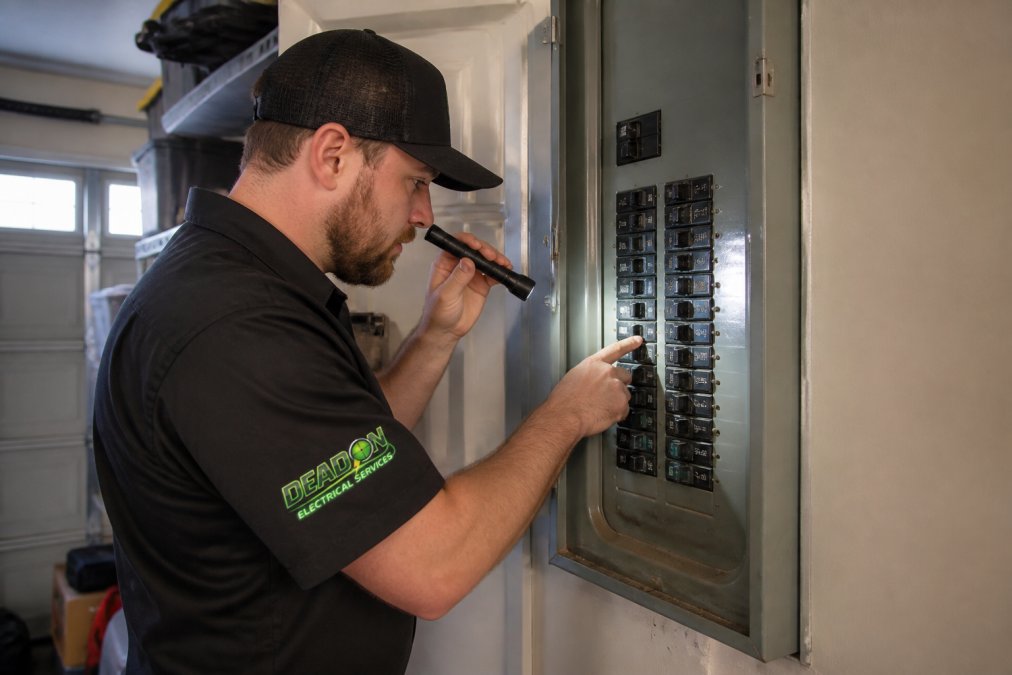
Watch for these indicators:
- The breaker trips at very low loads. If a circuit trips when only one or two low-draw devices are running, and the math shows you’re well under capacity, the breaker may be failing internally.
- The breaker feels warm or hot to the touch. A breaker that’s noticeably hot indicates excessive resistance, a sign of a loose connection or internal fault.
- Visible burn marks, scorch discoloration, or a burning smell at the panel. Do not ignore this. Turn off the main breaker and call an electrician.
- The breaker won’t reset or immediately trips again after resetting. A healthy breaker that’s tripped due to overload will reset and hold once the overload is removed. One that won’t hold is either still seeing a fault or is internally damaged.
- The breaker handle feels loose or doesn’t click firmly into position. Internal mechanism wear can prevent proper operation.
Older panels, particularly those found in homes built in the 1970s and 1980s, are more prone to breaker failures. Some older panel brands have documented reliability issues that the U.S. Consumer Product Safety Commission has addressed over the years.
How to Reset a Tripped Breaker Safely
Resetting a tripped breaker is one of the few electrical tasks a homeowner can safely perform, but only when the cause of the trip is understood and addressed first.
A tripped breaker sits in a middle position between ON and OFF. On most panels, it’s visually obvious: the handle sits slightly off-center, or a red or orange indicator window appears.
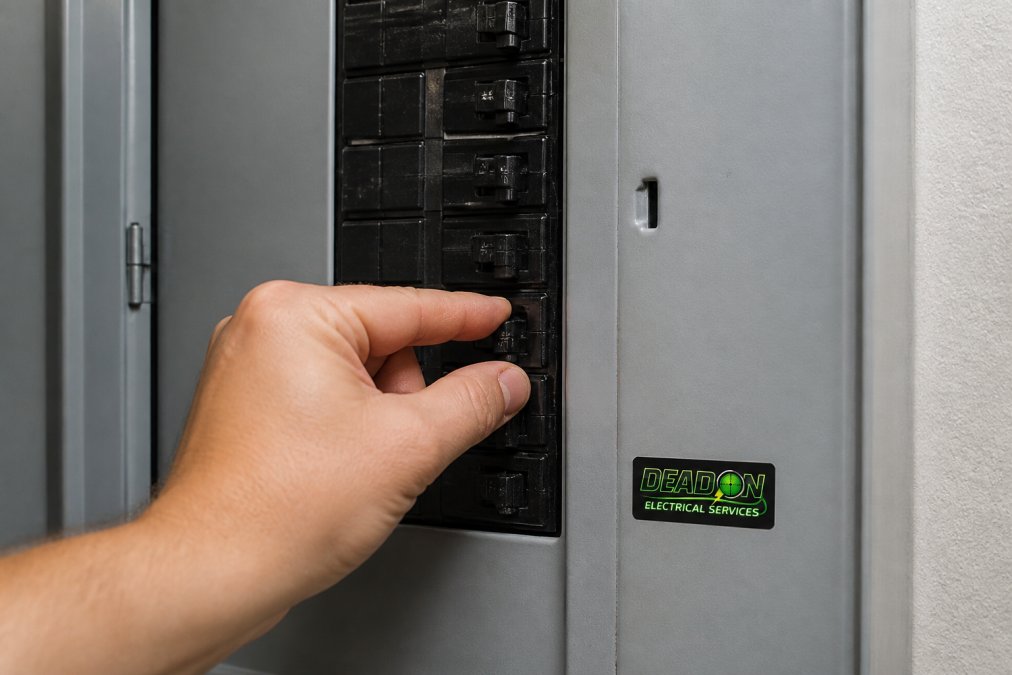
Follow these steps:
- Identify and remove the cause. Before touching the breaker, unplug devices on the circuit or turn off the switch that caused the trip. If you don’t know the cause, don’t reset yet.
- Turn the breaker fully to the OFF position. Move it firmly to OFF first to clear the trip mechanism.
- Pause for 30 seconds. This allows any residual heat in the breaker to dissipate.
- Push the breaker firmly to the ON position. You should feel and hear a click.
- Restore loads gradually. Plug devices back in one at a time and observe whether the breaker holds.
If the breaker trips again immediately after resetting, stop. Do not keep resetting it. A breaker that trips repeatedly is telling you there’s still a fault on the circuit.
Dedicated Circuit Requirements for High-Draw Appliances
One of the most common underlying reasons breakers keep tripping is that high-draw appliances are sharing circuits they were never meant to share. Certain appliances require a dedicated circuit, a circuit that serves only that one device.
The National Electrical Code guidelines on dedicated circuits specifies dedicated circuit requirements for appliances including:
- Electric ranges and cooktops
- Electric dryers
- Dishwashers
- Refrigerators
- Microwave ovens
- Air conditioning units
- Electric water heaters
Level 2 EV chargers require a dedicated 240-volt circuit, typically rated at 40 or 50 amps depending on the charger’s output. This is one of the most common dedicated circuit installations we handle, and it requires a licensed electrician to install the circuit, breaker, and proper wiring to code.
Hot tubs and pool equipment, common in the Las Vegas Valley, similarly require dedicated circuits with appropriate GFCI protection. Running pool pumps or spa heaters on shared circuits is both a code violation and a reliable way to keep tripping breakers.
|
Appliance |
Typical Circuit Requirement |
Breaker Type |
|---|---|---|
|
Standard outlets |
15 or 20 amp, 120V |
Standard or AFCI |
|
Kitchen small appliances |
20 amp, 120V |
Standard or AFCI |
|
Refrigerator |
20 amp, 120V dedicated |
Standard |
|
Microwave |
20 amp, 120V dedicated |
Standard |
|
Dishwasher |
20 amp, 120V dedicated |
Standard |
|
Electric dryer |
30 amp, 240V dedicated |
Standard |
|
Electric range |
50 amp, 240V dedicated |
Standard |
|
Level 2 EV charger |
40-50 amp, 240V dedicated |
Standard |
|
Hot tub / spa |
50-60 amp, 240V dedicated |
GFCI required |
If an appliance on this list is sharing a circuit with other devices, that’s likely the reason your breaker keeps tripping.
AFCI and GFCI Breakers: Why They Trip Differently
Standard breakers respond to overcurrent. AFCI and GFCI breakers respond to different types of faults entirely, which is why they trip under conditions that would leave a standard breaker unaffected.
GFCI breakers (Ground Fault Circuit Interrupter) monitor the difference in current between the hot and neutral conductors. When that difference exceeds about 5 milliamps, indicating current is leaking to ground, the GFCI trips within milliseconds. GFCI protection is required by code in bathrooms, kitchens, garages, outdoors, and near pools and spas.
GFCI breakers trip for reasons unrelated to overloading:
- Moisture inside an outdoor outlet or fixture
- A deteriorating appliance with insulation breakdown
- A faulty pool pump or spa motor with current leakage
AFCI breakers (Arc Fault Circuit Interrupter) detect the electrical signature of arcing, the dangerous sparking that occurs inside damaged wiring, loose connections, or where a nail has been driven through a wire inside a wall. Arcing is a leading cause of residential electrical fires, and AFCI breakers are now required by the National Electrical Code in most living areas of newly constructed homes.
AFCI breakers trip for reasons including:
- Damaged extension cords or appliance cords with cracked insulation
- Loose wire connections at outlets, switches, or fixtures
- Wiring damage from pests, construction, or age
According to the Electrical Safety Foundation International, arc faults are responsible for a significant portion of residential electrical fires each year. An AFCI breaker that trips repeatedly isn’t being overly sensitive, it’s detecting something worth investigating.
If a GFCI breaker trips, start by looking for moisture or a failing appliance. If an AFCI breaker trips, look for damaged cords and loose connections. If you can’t find the cause, or the breaker trips with nothing plugged in, call a licensed electrician.
If your breakers keep tripping and the cause isn’t obvious from the steps above, the next call should be to a licensed electrician. Dead On Electrical Services has been serving homeowners throughout the Las Vegas Valley since 2018, handling everything from tripped breaker diagnosis and panel evaluations to dedicated circuit installations and GFCI troubleshooting. We’re licensed and insured. Call Dead On Electrical Services to schedule a diagnostic visit and get a straight answer about what’s happening in your panel.
Frequently Asked Questions
Should I be worried if my breaker keeps tripping?
A breaker that trips once after an obvious overload is doing its job. A breaker that trips repeatedly, trips with nothing plugged in, or trips without a clear cause is a warning sign. It could indicate faulty wiring, a failing breaker, or a circuit that's undersized for your actual electrical load. Repeated tripping without a clear cause warrants a professional inspection — ignoring it raises the risk of overheating and electrical hazards.
How many times can a circuit breaker trip before it needs replacement?
There's no fixed number. Circuit breakers are designed to trip and reset repeatedly, but each trip puts mechanical stress on the internal components. A breaker that has tripped dozens of times over years of normal use may still function reliably. One that trips frequently in a short period, fails to hold after resetting, or feels hot to the touch is likely worn out or undersized and should be evaluated by a licensed electrician.
What is the difference between an overloaded circuit and a short circuit?
An overloaded circuit occurs when the total amperage draw of connected devices exceeds the circuit's rated capacity — the breaker trips to prevent overheating. A short circuit happens when a hot wire contacts a neutral or ground wire directly, causing a sudden surge of electrical current. Short circuits often trip the breaker instantly and may produce a burning smell, a pop, or visible scorching at an outlet. Short circuits always require a licensed electrician to diagnose and repair.
Can extreme heat affect my home's electrical panel performance?
Yes. High ambient temperatures reduce a breaker's ability to dissipate heat, which can cause breakers to trip at loads they would normally handle without issue. Panels installed in garages, utility rooms, or exterior locations without adequate ventilation are especially vulnerable during summer. If your breakers trip more frequently during hot months, have a licensed electrician inspect the panel's location, ventilation, and overall condition.
This article was written using GrandRanker