
Table of Contents
- What Bathroom exhaust fan installation in Las Vegas involves
- What You’ll Need Before the Work Starts
- Installing a Bathroom Fan Timer Switch
- Bathroom Fan Electrical Troubleshooting
- What Affects the Cost of Bathroom Exhaust Fan Installation
- Common Mistakes We See on Bathroom Fan Jobs
- Frequently Asked Questions
Last Updated: September 28, 2026
What Bathroom exhaust fan installation in Las Vegas involves
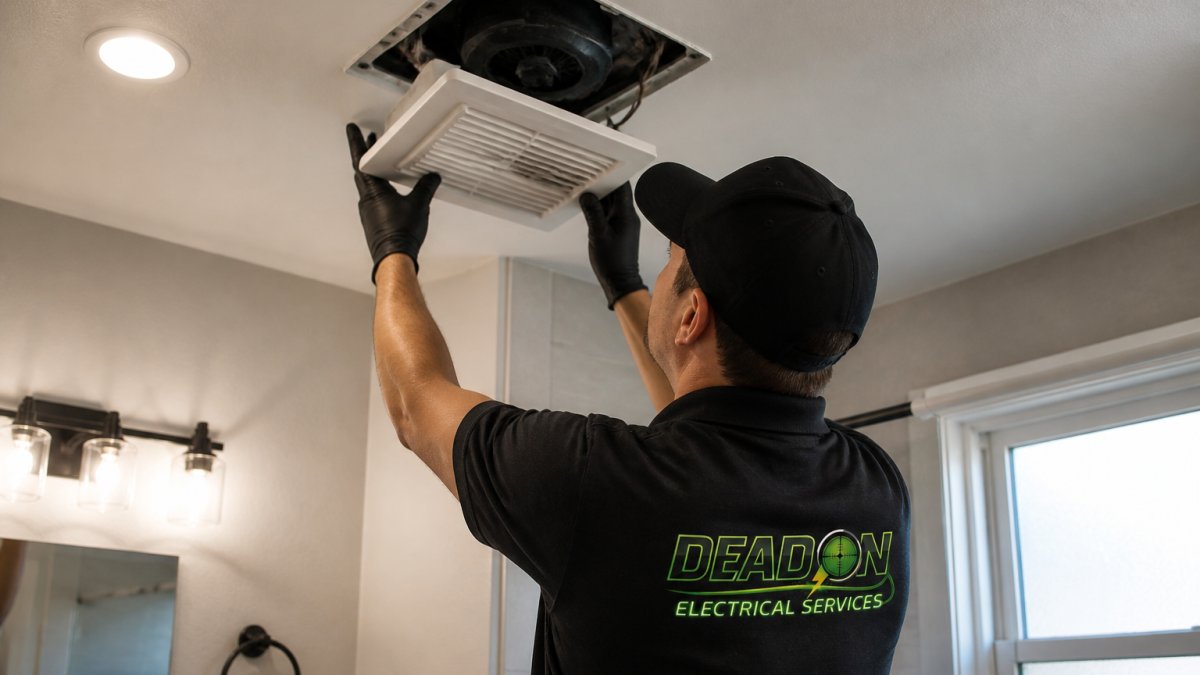
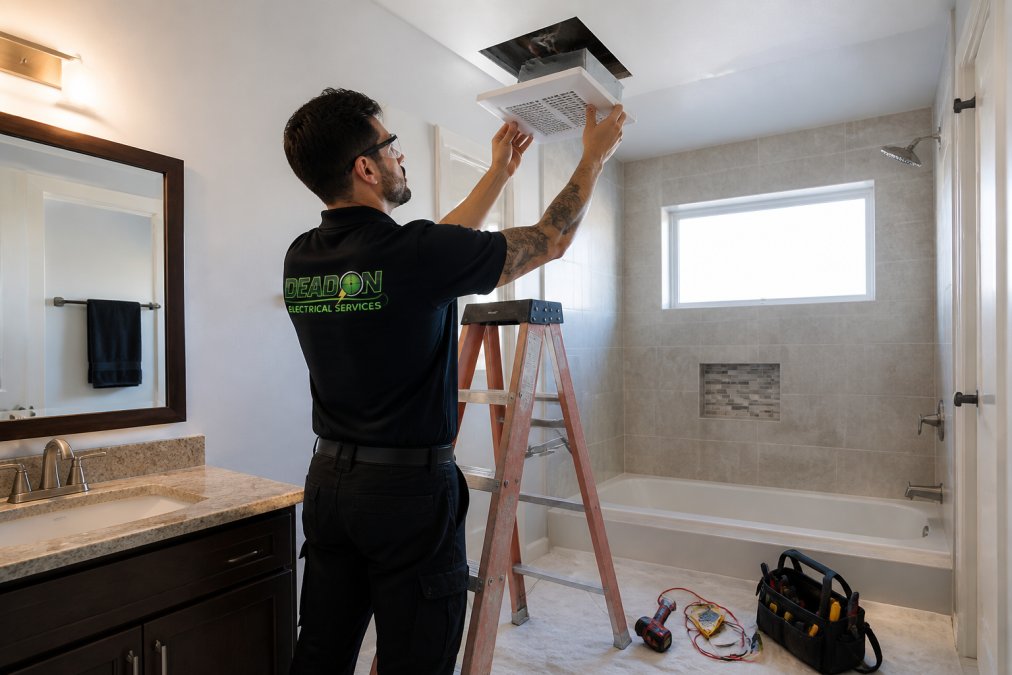
Bathroom exhaust fan installation in Las Vegas often involves electrical wiring installation or modification, whether you are replacing an old unit or adding ventilation where none exists. The fan needs a power source, a switching method, and a safe connection, whether you are replacing an old unit or adding ventilation where none exists.
Why Las Vegas Homes Need a Working Ventilation System
Even in Las Vegas’s dry climate, bathrooms generate concentrated moisture during showers and baths. A properly working exhaust fan helps remove that moisture before it collects on ceilings, walls, and finishes.
What You’ll Need Before the Work Starts
Before anyone opens a box or climbs into an attic, the electrical side of the job has to be planned. A bathroom exhaust fan is a small motor, but it still needs a correctly sized circuit, a proper switch leg, and a wiring method that holds up in a wet, humid room. Skipping this step is how homeowners end up with a fan that trips a breaker or a timer switch that never powers on.
Start With the Fan’s Electrical Load
Every fan has a nameplate rating. Most residential bathroom fans draw well under an amp, and fan/light combination units draw more because of the light. That number matters because it tells you whether the existing circuit can absorb the new load or whether a dedicated circuit makes more sense.
A few practical checks before the work starts:
- The model, CFM rating, and amp draw of the new fan (or fan/light combo)
- Whether the existing circuit is dedicated to the bathroom or shared with receptacles and lights
- Whether the switch box has a neutral wire, many digital timers and humidity sensors require one
- Attic or crawl space access above the bathroom, and how far cable has to travel
- The condition of existing wiring: cloth-insulated, aluminum branch circuits, or backstabbed receptacles on the same circuit all change the plan
- Panel capacity, an older panel that is already full may not accept a new breaker without other work
Choosing the Right Fan Size (CFM)
CFM, or cubic feet per minute, is the fan’s air-moving capacity. The common industry rule of thumb is 1 CFM per square foot of bathroom floor area, with a minimum of 50 CFM for any full bathroom. A 5 ft x 8 ft bathroom (40 sq ft) generally calls for at least a 50 CFM fan. A larger primary bathroom may need 80 to 110 CFM or more.
Two adjustments matter in Las Vegas homes:
- Add capacity for heavy moisture. Jetted tubs, dual showerheads, and steam showers push humidity faster than a standard shower. Many installers bump the CFM rating up one step in those rooms.
- Match the duct, not just the fan. A 110 CFM fan choked down to a long, undersized duct will not move 110 CFM of air. Duct sizing and run length are installation considerations, but they affect whether the electrical upgrade you paid for actually performs.
Fan/Light Combinations and Switch Legs
A fan/light combo needs more than one switch leg if you want the light and fan to operate independently. That usually means running an additional conductor from the switch box to the fixture, or using a combination switch or smart control that handles both functions. If the existing wiring is a simple switch loop with no neutral, adding a fan/light combo with a timer or humidity sensor often requires new cable, which is licensed electrician work, not a swap-in.
Tools and Materials (For Reference)
If a licensed electrician is doing the wiring, you do not need to supply these. This list is here so homeowners understand what the job involves:
- Voltage tester and non-contact circuit tester
- Wire nuts, electrical tape, and a junction box if one is required
- Properly sized cable if a new circuit or switch leg is needed
- Manufacturer-specified mounting brackets or housing supports.
- A GFCI-protected feed where the circuit serves bathroom receptacles
Installing a Bathroom Fan Timer Switch
Installing a bathroom fan timer switch is one of the most useful upgrades for a Las Vegas bathroom. A timer lets the fan run long enough to clear moisture without leaving it on all day.
Timer, Humidity Sensor, or Standard Switch?
Each option fits a different situation.
- Standard switch: Cheapest, but relies on someone remembering to turn it off.
- Timer switch: Runs the fan for a set period, then shuts off automatically.
- Humidity sensor: Turns the fan on when moisture rises and off when it clears. Best for bathrooms with heavy shower use.
For most Las Vegas homes, a timer or humidity sensor is the better choice. The fan runs when it should, and you stop paying to ventilate an empty room.
Bathroom Fan Electrical Troubleshooting
Most fan problems trace back to power, the switch, or the connection. Here is how to narrow it down.
- Fan does not run at all: Check the breaker first, then the switch and the wire connections at the fan.
- Fan hums but does not spin:Fan hums but does not spin: The blower may be obstructed, the motor may be failing, or another internal component may have failed. Confirm proper voltage before replacing the fan
- Breaker trips when the fan turns on: Breaker trips when the fan turns on: Possible causes include a wiring fault, ground fault, failing motor, damaged fan, or circuit problem that should be diagnosed.
- Fan runs intermittently: Loose connections at the switch or junction box are a common cause.
When It’s Time to Call a Licensed Electrician
Call a licensed electrician when the problem involves the panel, a new circuit, damaged wiring, or anything you cannot trace with a tester. Bathroom electrical work sits in a wet environment, and mistakes there are not worth the risk.
What Affects the Cost of Bathroom Exhaust Fan Installation
Pricing for bathroom exhaust fan installation depends almost entirely on the electrical scope, not the fan itself. A straight replacement of an existing fan on an existing circuit is the simplest job. Adding a fan where none existed, running new cable, or installing a new circuit changes the picture significantly.
The Scope Ladder
Think of the work as a ladder, from simplest to most involved:
- Direct replacement. The old fan comes out, the new one goes in on the same circuit and switch leg. The wiring is already there and in good condition. This is the shortest job.
- Replacement with a new switch. The fan swaps out, but you are upgrading from a standard switch to a timer or humidity sensor. If the switch box has a neutral, this is straightforward. If it does not, new cable has to be run from the switch to the fan or from the circuit to the switch box.
- New fan where none existed. No existing circuit, no switch leg, no ceiling cutout. This means running new cable, installing a switch box, and possibly adding a breaker.
- New dedicated circuit. If the panel is full or the existing bathroom circuit cannot carry the additional load, a new breaker and circuit are needed. This is the most involved scenario and the one most likely to require a panel evaluation.
What Moves the Number
- Whether an existing circuit and switch leg can be reused
- Attic access, a clear, walkable attic is faster to work in than a low-clearance space with blown-in insulation
- How far cable has to run from the panel to the bathroom
- Whether a new breaker or circuit is needed
- The type of switch: standard, timer, or humidity sensor
- Panel capacity and the age of the wiring
- Whether the bathroom circuit is GFCI-protected and whether that protection is working correctly
Permits and Inspections
Permit requirements for bathroom exhaust fan installation vary by jurisdiction. In many areas, a like-for-like fan replacement on an existing circuit does not require a permit, while adding a new circuit or running new wiring does. The specific rules depend on the local building department and the scope of work.
GFCI and Bathroom Circuit Considerations
Bathroom circuits that serve receptacles are typically GFCI-protected. If the fan shares that circuit, a GFCI trip can take the fan down with it. That is not a fan failure, it is the GFCI doing its job. But it also means the fan’s behavior is tied to the GFCI device, and a worn or miswired GFCI can cause intermittent problems that look like fan issues.
Getting an Accurate Estimate
We do not quote prices over the phone for work we have not seen. The variables above, circuit capacity, attic access, wiring condition, switch type, are not things you can assess from a description. Call Dead On Electrical Services for a service estimate, and we will look at the actual conditions before giving you a number. If your project also involves replacing the switch, our Light Switch Replacement page covers what that involves.
Common Mistakes We See on Bathroom Fan Jobs
The same problems show up on job after job. A common mistake is tapping into an existing bathroom circuit without first verifying what else the circuit serves, its available capacity, and whether adding the fan is appropriate.
Frequently Asked Questions
How much does it cost to have someone install a bathroom exhaust fan?
It depends on the job. Replacing an existing fan that already has power and a vent is simpler than adding a new fan where wiring and ductwork have to be run. Ceiling height, attic access, and whether a new circuit is needed all change the scope. Dead On Electrical Services does not publish flat rates because every bathroom is different. Call for a service estimate and you’ll get an honest assessment of the work before anything starts.
Do I need an electrician to install a bathroom exhaust fan?
For a straight swap where the wiring, switch, and vent already exist, some handy homeowners handle it themselves. But if the circuit needs to be extended, a new switch or timer installed, or the fan/light combination wired to a single-switch circuit, that often involves more extensive electrical work and may require a licensed electrician depending on the scope and local requirements. Bathroom circuits sit near water, so GFCI protection and correct grounding matter. An electrician confirms the circuit can handle the load and that the work meets current code.
What are the electrical safety requirements for bathroom fans?
Bathroom receptacle circuits are generally required to have GFCI protection, and fans must be on a circuit sized for the motor load with proper grounding. The fan housing must be bonded, connections made inside an approved electrical junction box, and wiring rated for the location. Older Las Vegas homes sometimes have wiring that was never designed for a modern fan/light unit. An electrician can verify the circuit, breaker, and connections before the fan goes in.
How do I troubleshoot a bathroom exhaust fan that won’t turn on?
Start simple: check the breaker, then the switch or timer. If those are fine, the problem is often at the fan itself, a loose connection, a failed motor, or a tripped GFCI upstream. A fan that hums but doesn’t spin usually has a bad motor or a stuck blade. If you’ve checked the breaker and switch and it still won’t run, stop there. Diagnosing wiring inside a bathroom ceiling is a job for a licensed electrician.