
Table of Contents
- What Actually Drives Las Vegas Electrical Repair Pricing
- Why the Same Repair Costs More in One House Than Another
- Why Electrical Service Calls Have a Base Fee
- Residential Electrical Troubleshooting: How Diagnosis Affects Your Bill
- Electrical Panel Replacement Cost Factors Homeowners Should Know
- How Home Age and Extreme Heat Change Repair Complexity
- How to Get an Accurate Electrical Repair Quote
- Conclusion
- Frequently Asked Questions
Last Updated: September 14, 2026
What Actually Drives Las Vegas Electrical Repair Pricing
Las Vegas electrical repair pricing is not a flat menu. Two homes on the same street can get quoted differently for what sounds like the identical problem, and there’s usually a reason for it. At Dead On Electrical Services, we’ve worked in Las Vegas Valley homes since 2018, and the pattern is consistent: the bill reflects how hard the problem is to find, how hard it is to reach, and what the fix requires.
That’s the core argument of this article. Most homeowners assume they’re paying for a part. In practice, they’re paying for diagnosis, access, and labor time, with parts as a smaller line item than expected.
Below, we break down what actually drives cost, why a service call carries a base fee, and how to compare quotes so you’re comparing the same job.
Why the Same Repair Costs More in One House Than Another
The biggest mistake homeowners make is comparing a repair by its symptom instead of its conditions. A dead outlet in a 1970s ranch house with original wiring is a different job than a dead outlet in a 2015 build with a clean panel and labeled breakers.
What changes the number:
- Wiring era and material. Older homes may have aluminum branch wiring, cloth-insulated conductors, or no equipment ground. Each one changes how a circuit can be repaired safely.
- Panel condition and labeling. A clearly labeled panel saves diagnostic time. An unlabeled one with mismatched breakers adds it.
- Access. Attic runs in summer, slab-fed circuits, and finished walls all slow the work down.
- Whether the fault is a single device or the circuit feeding it. Replacing an outlet takes minutes. Tracing an intermittent fault through a circuit can take considerably longer.
This is why two quotes for “my lights flicker” can land far apart. They may not be quotes for the same scope of work.
Why Electrical Service Calls Have a Base Fee
A base service call fee covers the trip, the truck stock, and the technician’s time to arrive and begin evaluating your system. It exists because the visit has a cost whether or not the repair is a five-minute fix.
What that fee typically includes:
- Travel to your address within the service area
- An initial safety check of the affected circuit and panel
- Meter testing to confirm what’s actually happening
- A scope of work and a price before repair begins
What it does not include is the repair itself, unless the provider bundles diagnosis into the repair price. Ask which model applies before you book. Some companies waive the diagnostic fee if you approve the repair; others charge it separately. Neither approach is wrong, but you should know which one you’re getting.
Residential Electrical Troubleshooting: How Diagnosis Affects Your Bill
Residential electrical troubleshooting is the process of isolating where a fault originates before any repair is made, and it is usually the largest variable in what you pay. A technician who guesses replaces parts until something works. A technician who diagnoses finds the actual failure point.
What Happens During a Standard Diagnostic Visit
The visit follows a fairly standard sequence:
- Interview. What turns on, what doesn’t, when it started, and whether anything changed recently, like a new appliance or a storm.
- Panel inspection. Breakers, bus bars, and any signs of heat, arcing, or corrosion.
- Circuit isolation. Testing at the panel, then at devices along the circuit, working toward the failure.
- Load testing. Confirming the circuit holds under load, not just at rest.
- Written scope. What failed, what it takes to fix, and what it costs.
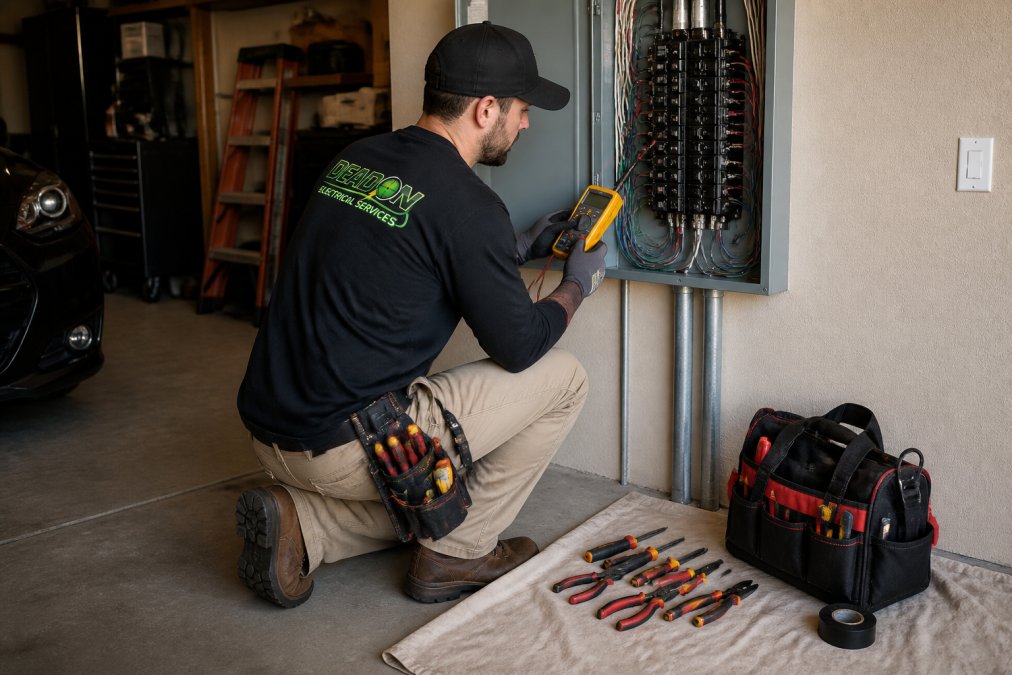
The thing nobody tells you about intermittent problems, like flickering lights that three previous electricians couldn’t pin down, is that they often trace to a loose neutral or a backstabbed outlet connection rather than anything dramatic. Finding it is methodical work, and that work is what you’re paying for.
Electrical Panel Replacement Cost Factors Homeowners Should Know
Electrical panel replacement cost factors come down to the panel itself, the service entrance, and what has to change to bring the system up to current standards. The panel box is rarely the expensive part.
The main drivers:
| Cost Factor | What Changes the Number | Typical Impact |
|---|---|---|
| Panel amperage | 100A vs. 200A service | Higher capacity, higher material cost |
| Service entrance | Mast, meter base, conductors | Added labor and coordination |
| Circuit count | Number of breakers moved | More labor hours |
| Grounding and bonding | Existing electrode condition | May require new grounding |
| Wall and access | Stucco, drywall, tight clearance | Repair and finish time |
| Permit and inspection | Local jurisdiction requirements | Added administrative step |
A 30-year-old panel that’s full, warm to the touch, or fitted with breakers that no longer trip reliably is worth having evaluated. That’s a diagnosis question, not a guess, and it’s one a licensed electrician should answer on site.
How Home Age and Extreme Heat Change Repair Complexity
Summer heat in the Las Vegas Valley is hard on electrical systems in ways that don’t show up in milder climates. Attics routinely reach temperatures that degrade insulation on older conductors, and outdoor equipment takes a beating year after year.
Where this shows up most:
- Pool and spa equipment. Pump motors, timers, transformers, and lighting run in direct sun. GFCI protection on pool circuits matters more here, not less.
- Outdoor outlets and fixtures. Sun-bleached covers, cracked boxes, and corroded terminations are common.
- Attic-run circuits. Working in a 140-degree attic takes longer, and that time is real.
- Older panels under continuous load. Air conditioning runs longer here, and a panel that was adequate decades ago may not be now.
The Occupational Safety and Health Administration guidance on heat-related workplace hazards explains why attic and outdoor work in extreme heat requires pacing and precautions, which affects how long a job takes.
How to Get an Accurate Electrical Repair Quote
An accurate quote starts with an on-site diagnosis, not a phone description. Anyone who prices a repair without seeing the panel and testing the circuit is estimating, and estimates move.
Use this checklist when you request a quote:
- Describe the symptom precisely: which devices, which rooms, when it happens
- Note your home’s approximate age and whether the panel has ever been replaced
- Ask whether the diagnostic fee is separate or credited toward the repair
- Request the scope in writing: what will be replaced, and what won’t
- Confirm the provider is licensed and insured, and ask for the license number
- Ask whether a permit is required for the work
- Get the warranty terms on labor and parts in writing
- Confirm the quote covers the full repair, not just the diagnosis
The real difference between a quote you can trust and one you can’t usually comes down to whether the provider wrote down what they found.
Conclusion
Electrical problems rarely announce themselves clearly, and that ambiguity is exactly what makes pricing hard to predict from a phone call. The honest answer is that diagnosis, access, and condition drive the number far more than the parts do.
Dead On Electrical Services is a licensed and insured local contractor serving homeowners and property owners across the Las Vegas Valley, including Henderson, North Las Vegas, and Summerlin. We offer same-day service, and we extend a 10% discount for military, seniors, and first responders. Our work covers troubleshooting and repair, panel replacement, GFCI and outlet service, Level 2 EV charger installations, dedicated 240V circuits, recessed lighting, ceiling fans, and pool and spa electrical work.
Call now to schedule a diagnostic visit and get a written scope before any repair begins.
Frequently Asked Questions
What factors influence the cost of electrical repairs?
Several things decide what a repair runs: how hard the problem is to find, how long the fix takes, the parts needed, and how easy it is to reach the wiring. A loose outlet in an open wall is simpler than a tripping breaker traced through a finished ceiling. Age of the home, aluminum versus copper wiring, and whether a permit is required all factor in. Because of that, any honest electrical repair pricing conversation starts with a diagnosis, not a flat number over the phone.
Why do electrical service calls have a base fee?
A base fee covers getting a licensed electrician to your property, the time spent testing circuits and tracing the fault, and the equipment used to do it safely. Troubleshooting is real work, even when the final repair is small. That fee also protects you from guesswork: the electrician identifies the actual cause before quoting the fix, so you are not paying to replace parts that were never the problem.
When should I call a professional for residential electrical troubleshooting?
Call a licensed electrician for anything involving a breaker that trips repeatedly, burning smells, warm outlets or switch plates, sparking, partial power loss, or a panel you are not sure about. Flickering lights across several rooms, GFCI outlets that will not reset, and pool or spa equipment acting up also warrant a professional visit. Homeowners can safely reset a breaker or replace a bulb, but opening a panel or chasing wiring inside a wall is not a do-it-yourself job.
How does the age of a home affect electrical repair complexity?
Older homes often have smaller panels, two-prong outlets, or wiring that was never designed for today’s loads. That means a simple repair can turn into a bigger job once the electrician sees what is behind the wall. In the Las Vegas Valley, heat also ages insulation, breakers, and outdoor equipment faster. A home built decades ago may need parts that are no longer standard, which adds time and material to the job. A diagnostic visit sorts out what you are actually dealing with.