
Last Updated: November 7, 2026
Quick Summary
Signs your Las Vegas home needs a 200 amp service include breakers that trip whenever the AC kicks on, lights that dim when large appliances start, and a panel with no open spaces left for an EV charger, spa, or added HVAC. A load calculation, not square footage, confirms whether a 200 amp service is actually warranted.
- A 200-amp panel on a 100-amp service is just a bigger box; conductors and meter base must match.
- A Level 2 charger needs two open breaker spaces and enough spare service capacity.
- Panel replacement swaps the box and breakers but does not change service capacity.
- A full service upgrade adds service entrance conductors, meter base, permits, and utility coordination.
- Ask whether the quote includes the service entrance conductors and meter base before you sign.
Table of Contents
- Why Las Vegas Homes Push Electrical Service to Its Limits
- Signs of an Overloaded Electrical Panel You Should Not Ignore
- How to Confirm Your Service Size Without Opening the Panel
- The Electrical Load Calculation for a Home, Explained Simply
- EV Charger Electrical Panel Capacity: What a Level 2 Charger Really Adds
- When an Electrical Service Upgrade for Pool or Spa Equipment Makes Sense
- Panel Replacement vs. a Full 200 Amp Service Upgrade
- Schedule a Panel Evaluation with Dead On Electrical Services
- Frequently Asked Questions
Why Las Vegas Homes Push Electrical Service to Its Limits
Most Las Vegas homes were wired for a different era of living.
That gap between original design and current demand is why so many homeowners start searching for signs your Las Vegas home needs a 200 amp service upgrade. The pattern is consistent: the symptoms show up long before the panel actually fails.
Las Vegas heat makes it worse. Las Vegas heat can add significant demand because air conditioning is often one of the largest electrical loads in the home and may run for long periods during summer.
Below, we break down the warning signs, explain what a load calculation actually measures, and show you how to tell a simple panel replacement from a full service upgrade.
Signs of an Overloaded Electrical Panel You Should Not Ignore
An overloaded panel announces itself through small, repeatable symptoms. None of them guarantees you need a service upgrade, but each one is worth a professional look. If you recognize more than two on this list, it’s time for an evaluation.
Breakers That Trip Repeatedly
A breaker that trips repeatedly needs diagnosis. If it happens when a specific appliance or HVAC system starts, the problem could be the equipment, the branch circuit, a failing breaker, a loose connection, or insufficient available capacity.
Watch for breakers that trip when two appliances run at once, like the microwave and the toaster, or the dryer and the AC. That pattern points to a service with too little capacity rather than a faulty breaker. Our guide to why breakers keep tripping walks through the diagnostic side in more detail.
Flickering Lights, Warm Outlets, and Buzzing Sounds
Lights that dim when the AC starts are a classic sign of a service under strain. So is a panel cover that feels warm to the touch, or outlets that heat up under normal use.
Buzzing or crackling from the panel itself is different. That can indicate a loose connection or failing breaker, and it deserves prompt attention from a licensed electrician. A burning smell means stop using the panel and call right away.
If you’re wondering whether your existing equipment is safe, this breakdown of old electrical panel warning signs and risks covers what inspectors look for.
How to Confirm Your Service Size Without Opening the Panel
You can confirm your service size safely, without removing a panel cover. The main breaker inside the panel is labeled with its amperage, usually 100, 125, 150, or 200 amps.
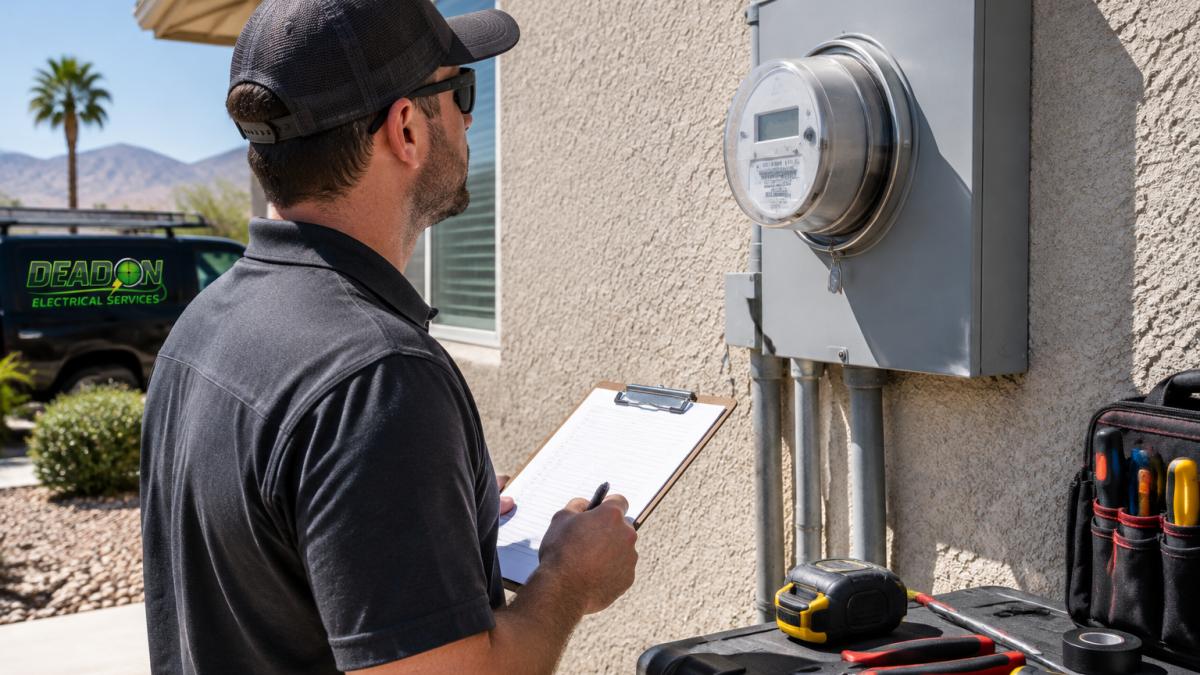
Never remove a dead front or panel cover to look inside. The main lugs stay energized even with the main breaker off. A licensed electrician should confirm service size and condition during an evaluation.
One more distinction matters. A 200-amp panel on a 100-amp service is just a bigger box. The service entrance conductors and meter base have to match, which is why the utility gets involved in a true upgrade.
The Electrical Load Calculation for a Home, Explained Simply
An electrical load calculation is a standardized method an electrician uses to add up every load a home could reasonably run at once, then compare that total to the service capacity. It follows the method laid out in NFPA 70, the National Electrical Code, which is the code basis for residential service sizing. The general method in Article 220 is where homeowners often get lost, so here is the plain-language version.
What Actually Goes Into the Math
The calculation starts with general lighting and receptacle load, figured by square footage. Then it adds the small appliance and laundry branch circuits, which carry a fixed minimum. From there, the electrician adds fixed appliances like the water heater, disposal, and dishwasher, then the largest motor load, and finally the heating and cooling equipment.
Electric ranges, dryers, and EV chargers get their own treatment because they are large dedicated loads. The calculation applies demand factors along the way, which is the code’s way of acknowledging that not every appliance runs at the same moment. A house with a gas range and gas dryer carries a much lighter calculated load than the same square footage with all-electric appliances.
Why Square Footage Alone Does Not Answer the Question
A 2,000-square-foot Summerlin home with a pool, a spa, and two AC units can carry a far heavier calculated load than a larger house with gas appliances and one HVAC system. Two houses of identical size can land on opposite sides of the 200-amp question depending on what is actually installed and what the owners plan to add.
That is why a contractor who quotes a service size over the phone without asking about appliances, HVAC tonnage, pool equipment, and future plans is guessing. The calculation is the difference between a recommendation and a sales pitch.
Reading the Result Honestly
The result tells you whether 100 amps is genuinely sufficient, whether a 200 amp service is warranted, or whether something in between fits. In some Las Vegas Valley homes, the calculation shows the existing service has headroom and the real problem is a worn panel or a failing breaker.
Watch out: a load calculation is only as good as the information fed into it.
If you want to understand what a panel project involves once the calculation points toward an upgrade, review our electrical panel replacement service.
EV Charger Electrical Panel Capacity: What a Level 2 Charger Really Adds
A Level 2 charger is the single biggest new load most Las Vegas homeowners add. It runs on a dedicated 240-volt circuit and draws continuous current for hours, which is a different demand profile than any appliance in the house.
That’s why EV charger electrical panel capacity questions come up in nearly every installation. The charger needs two open breaker spaces, a circuit sized for the unit, and enough spare capacity on the service to carry it alongside everything else.
In many homes, there’s room. In older Henderson and North Las Vegas properties with a 100-amp service, there often isn’t, especially with the AC running. A load calculation settles it.
If you’re planning a charger, our page on EV wall charger installation basics covers the circuit and equipment side.
When an Electrical Service Upgrade for Pool or Spa Equipment Makes Sense
Pool and spa equipment runs outdoors in extreme heat, which shortens the life of pumps, timers, and transformers. It also adds continuous load: a pool pump, a spa heater, a blower, and lighting can all draw at once.
If your pool or spa equipment needs attention, our spa electrical services page covers what we handle.
Panel Replacement vs. a Full 200 Amp Service Upgrade
These two jobs get used interchangeably, and they shouldn’t be. A panel replacement swaps the breaker box and breakers. A service upgrade replaces the panel plus the service entrance conductors, meter base, and often the mast and utility connections.
Here’s the practical difference:
|
What’s involved |
Panel replacement |
Full service upgrade |
|---|---|---|
|
Breaker panel and breakers |
Replaced |
Replaced |
|
Service entrance conductors |
Usually reused |
Replaced |
|
Meter base and mast |
Usually reused |
Often replaced |
|
Utility coordination |
Rarely needed |
Typically required |
|
Permits and inspection |
Required |
Required |
|
Changes service capacity |
No |
Yes |
If your panel is damaged or outdated but the service capacity is adequate, a replacement may be all you need. If the goal is more capacity for an EV charger, a spa, or added HVAC, the service itself has to change.
What a Service Upgrade Actually Involves Locally
A true 200-amp upgrade is a sequence, not a single afternoon. The contractor pulls an electrical permit from the local building authority, and the work is inspected before the utility will energize the new service.
That sequence is why timelines vary by project. A full upgrade involves more trades, more inspection points, and a utility schedule that the contractor coordinates but does not control.
Watch out: a homeowner who hires for a “panel swap” but actually needs a service upgrade can end up with a new box on an old, undersized service. That is the most expensive way to solve nothing, because the capacity problem remains and the new panel has to be opened up again later.
How to Tell Which One You Are Being Quoted
Ask directly whether the service entrance conductors and meter base are included. If the answer is no, you are being quoted a panel replacement, and it will not increase capacity. Ask whether the permit is being pulled and whether the utility disconnect is part of the scope. A legitimate quote answers both without hesitation.
If you are weighing a repair against a replacement, our guide to old electrical panel warning signs and risks covers when a panel is failing versus merely old. When the calculation points toward more capacity, our electrical panel replacement service outlines what the upgrade work includes.
Schedule a Panel Evaluation with Dead On Electrical Services
Guessing about your panel’s capacity is a bad bet. A proper evaluation confirms your service size, runs the load calculation, and tells you plainly whether you need a repair, a panel replacement, or a full service upgrade.
Dead On Electrical Services is a licensed and insured electrical contractor serving the Las Vegas Valley. We offer same-day service and a 10% discount for military, seniors, and first responders.
If your breakers trip, your lights dim, or you’re adding a charger or spa, call (725) 605-6888 to schedule an electrical service evaluation in Las Vegas, Henderson, Summerlin, or anywhere in the valley.
A panel that’s quietly running out of capacity won’t fix itself, and the symptoms rarely improve on their own.
Frequently Asked Questions
How do I know if my home needs 200 amp service?
You do not confirm it from symptoms alone. A licensed electrician reviews your panel rating, the size of the service entrance conductors, the meter base, and a load calculation based on what your home actually runs. Frequent breaker trips, flickering lights, warm outlets, or plans to add central air, an EV charger, or pool equipment are reasons to request that evaluation. Many Las Vegas homes run fine on 100-amp service, so the answer depends on measured demand and future plans, not age alone.
Can frequent breaker trips mean my home needs a service upgrade?
Sometimes, but not always. A breaker that trips repeatedly may be protecting a circuit with a loose connection, a failing appliance, or a ground fault rather than signaling a capacity problem. An electrician should test the circuit before anyone recommends a 200 amp service upgrade. If trips happen when several high-demand appliances run at once, that pattern points toward an overloaded circuit or limited service capacity worth evaluating with a load calculation.
Do I need 200 amp service to install an EV charger?
Not automatically. EV charger electrical panel capacity depends on your existing service size, the charger’s amperage, and what else runs in the home. Some owners add a Level 2 charger on a dedicated 240-volt circuit without a service change. Others need an upgrade because the panel has no open spaces or the calculated load leaves too little room. An electrician checks available capacity and panel condition before recommending either path.
Does every older Las Vegas home need a 200 amp electrical panel?
No. Age alone does not decide service size. A well-maintained 100-amp service can serve a modest home with gas appliances, while a newer house with electric cooking, central air, a pool, and an EV may need more capacity. The right answer comes from a load calculation and an inspection of the panel, wiring, and grounding. What matters is whether the service safely carries the home’s demand today and after planned additions.
