
Table of Contents
- What Affects EV Charger Installation Cost
- Level 2 EV Charger Installation Requirements
- Electrical Panel Upgrade for EV Charging
- EV Charger Permit Process and Inspections
- Labor vs. Hardware Costs Breakdown
- Incentives, Rebates, and Tax Credits
- Why Professional Installation Matters
- Getting Your Installation Quote
- Frequently Asked Questions
Last Updated: September 1, 2026
What Affects EV Charger Installation Cost
The cost of installing an EV charger in your home depends on several interconnected factors. Your electrical panel’s current capacity, the distance from the panel to your charging location, whether you need a service upgrade, local permitting requirements, and the complexity of the installation all play a role. Understanding these variables helps you get an accurate quote and avoid surprises during the project.
Your home’s existing electrical infrastructure is the biggest cost driver. If your panel has available capacity and you’re installing the charger close to it, the job is straightforward. If your panel is at capacity, outdated, or located far from where you want to charge, costs climb quickly. In the Las Vegas area, many older homes have 100-amp or 150-amp panels that struggle to support both household loads and a Level 2 charger simultaneously. That’s where panel upgrades come in, and they’re a significant line item.
The type of charger you choose also matters. A hardwired Level 2 EVSE (Electric Vehicle Supply Equipment) requires dedicated circuit installation and permanent wiring. A plug-in charger using a NEMA 14-50 outlet is less expensive to install but still demands proper amperage and a dedicated circuit. Neither option is cheap, but both are safer and more reliable than trying to charge from a standard outlet.
Distance matters too. Running conduit and wire 100 feet from your panel to a detached garage costs more than installing a charger 10 feet away in an attached garage. Conduit protection, wiring gauge requirements, and voltage drop calculations all increase with distance.
Finally, permitting and inspection fees vary by jurisdiction. Your local building department has specific requirements for EV charger installations, and you’ll need to budget for permit fees and inspection costs. Dead On Electrical Services handles these requirements as part of a professional installation, ensuring your setup meets current electrical code and passes inspection the first time.
Level 2 EV Charger Installation Requirements
A Level 2 charger requires a dedicated 240-volt circuit The circuit and wiring must be sized for the charger’s maximum continuous load and the installation conditions. EV chargers are considered continuous loads, so the branch circuit is typically sized at 125% of the charger’s maximum current. For example, a 40-amp EV charger is commonly installed on a 50-amp circuit. Wire size can also vary depending on the wiring method, conductor type, distance, and installation conditions.
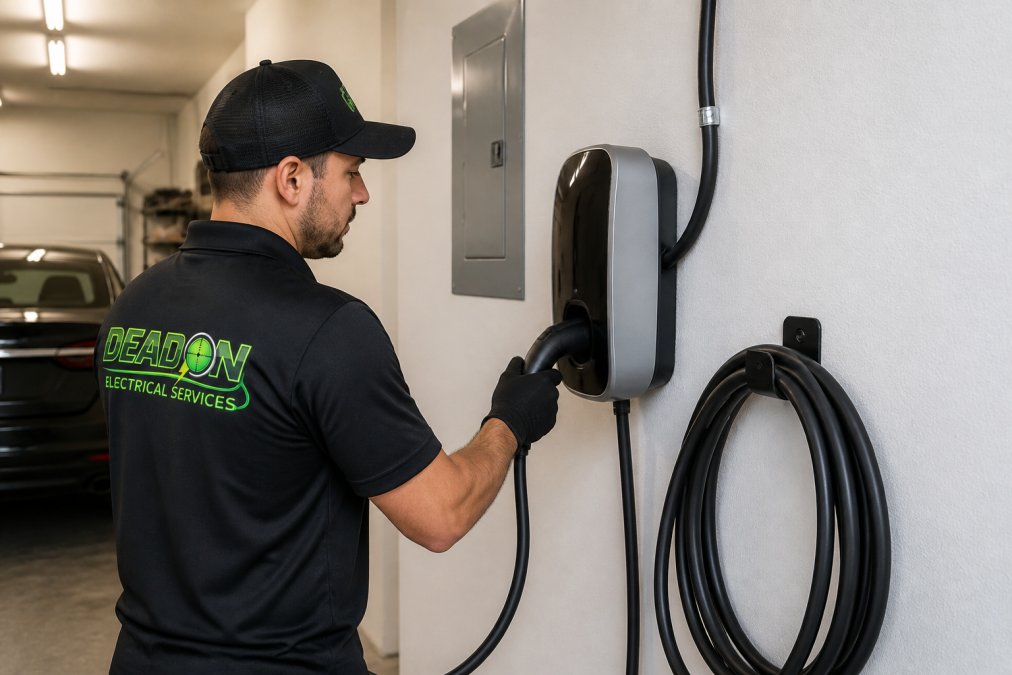
Your electrical panel must have available breaker slots and sufficient amperage capacity to support the charger without overloading your home’s service. A 200-amp main service is ideal, but many homes have 100 or 150 amps. If your panel is already at capacity, running air conditioning, water heater, electric range, and other major loads, adding a Level 2 charger may require a service upgrade to 200 amps.
The circuit itself must be properly sized and protected. A 50-amp charger needs 6-gauge wire and a 50-amp breaker. A 40-amp charger needs 8-gauge wire and a 40-amp breaker. A 30-amp charger needs 10-gauge wire and a 30-amp breaker. Undersizing the wire or breaker creates fire risk and won’t meet code. Oversizing wastes money without benefit.
Depending on the wiring method and installation location, conduit or other approved protection may be required where wiring is exposed to physical damage, weather, or other conditions. Outdoor installations also require materials rated for the environment.
A ground fault circuit interrupter (GFCI) is typically required for outdoor or wet-location chargers. Some chargers have built-in GFCI protection; others require a separate GFCI breaker in the panel. This protects against shock hazards if water contacts the equipment.
The charger itself must be listed and certified for residential use. A licensed electrician verifies that the EVSE meets National Electrical Code (NEC) standards and is appropriate for your specific installation.
Electrical Panel Upgrade for EV Charging
If your home’s electrical panel lacks the capacity for a Level 2 charger, a service upgrade becomes necessary. This is one of the most expensive parts of an EV charger installation cost, but it’s also one of the most important.
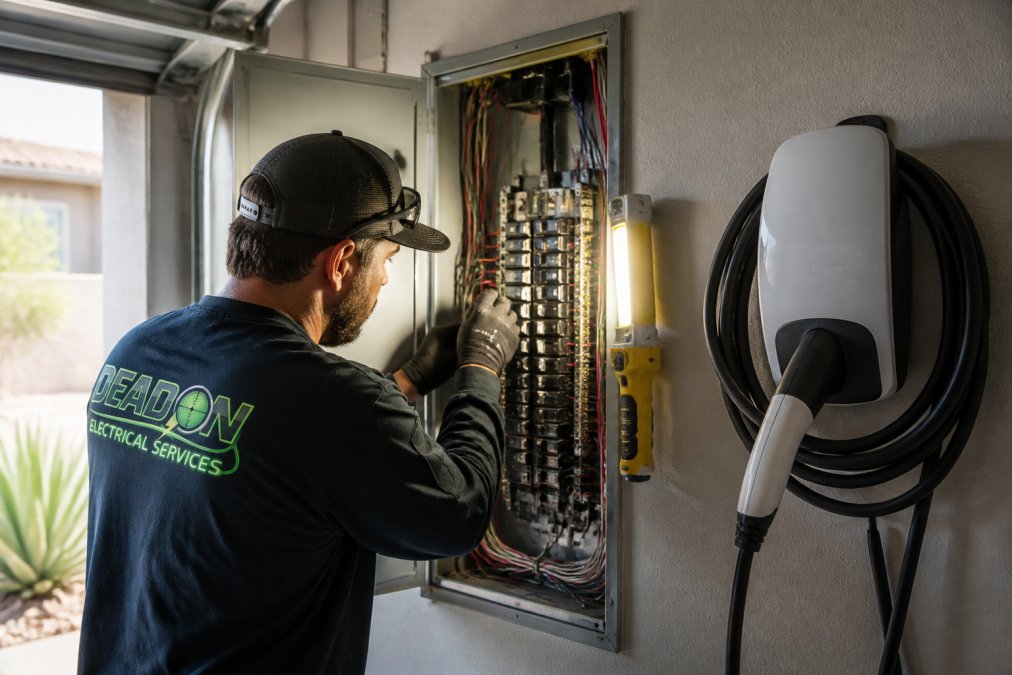
A service upgrade involves replacing your main breaker and potentially upgrading the service entrance from 100 or 150 amps to 200 amps. This is major work. The utility company may need to run new service lines from the street to your home, which adds both time and expense. Your meter base may need replacement. The main disconnect, breaker, and all related components must be sized correctly and installed to code.
In the Las Vegas Valley, older homes built in the 1970s and 1980s often have 100-amp panels that are simply inadequate for modern electrical loads plus EV charging. A 200-amp upgrade gives you room to grow and ensures your home can handle the charger without compromising other systems.
Load calculation is critical here. A licensed electrician calculates your home’s total electrical demand, air conditioning, heating, water heater, range, dryer, and all other loads, then adds the EV charger to determine if your current service is sufficient. If the total demand exceeds your panel capacity, an upgrade is required.
The upgrade process requires permits and inspections from your local building department. The utility company must inspect the new service entrance before energizing it. This adds time to the project but ensures everything is safe and compliant.
Some homes don’t need a full service upgrade. If your panel has available capacity and a free breaker slot, you may only need to run a new circuit to the charger location. A load calculation determines which path applies to your home.
EV Charger Permit Process and Inspections
EV charger installations may require an electrical permit and inspection depending on the jurisdiction and scope of work. Permit requirements can vary between Las Vegas, Henderson, North Las Vegas, and unincorporated Clark County. When permits are required, Dead On Electrical Services can help ensure the installation meets applicable electrical code and inspection requirements.
The permit process starts with submitting plans showing the charger location, circuit design, panel modifications, and conduit routing. Your electrician typically handles this paperwork. The building department reviews the plans to ensure they meet the National Electrical Code and local amendments. Once approved, work can begin.
An inspection happens after the circuit is roughed in but before the charger is energized. The inspector verifies that conduit is properly installed, wire is the correct gauge, breakers are properly sized, and grounding is correct. If anything doesn’t meet code, the inspector will flag it and you’ll need to fix it before getting approval to energize.
A final inspection occurs after the charger is installed and connected. The inspector confirms that the EVSE is properly mounted, all connections are secure, and the circuit operates safely.
Inspection requirements vary slightly between jurisdictions in the Las Vegas area. Henderson, North Las Vegas, and unincorporated Clark County each have their own building departments with slightly different processes. Dead On Electrical Services knows the specific requirements for your location and ensures your installation passes inspection on the first try.
Permit and inspection timelines vary depending on the jurisdiction, project scope, and current building department scheduling.
Labor vs. Hardware Costs Breakdown
An EV charger installation cost breaks down into two main categories: hardware and labor. Understanding this breakdown helps you see where your money goes.
Hardware includes the EVSE unit itself, electrical wire, conduit, breakers, disconnect switches, and any panel modifications. The charger unit ranges from basic plug-in models to smart chargers with WiFi connectivity. Wire and conduit costs depend on the distance from your panel to the charger and the amperage required. A 50-amp circuit requires heavier wire than a 30-amp circuit, which affects material costs.
Labor covers the electrician’s time to design the circuit, run conduit, pull wire, install breakers, connect the charger, and test the system. If your installation requires a service upgrade, labor costs increase significantly because the work is more complex and time-consuming. An electrician must coordinate with the utility company, manage multiple inspections, and ensure everything is done safely and to code.
For many residential EV charger installations in the Las Vegas area, installation costs typically range from about $685 to $2,400. A straightforward installation with the charger located near the electrical panel will usually be toward the lower end of that range. Longer wire and conduit runs, such as installing a charger on the opposite side of the garage, can increase the cost. Panel upgrades or other electrical work, if needed, would add to the total price.
Permitting and inspection fees are separate from both hardware and labor. Your building department charges a permit fee based on the estimated project cost. Inspection fees may be included in the permit or charged separately. These fees are not negotiable, they’re set by your local jurisdiction.
A licensed electrician provides a detailed quote that breaks down hardware, labor, and fees so you understand exactly what you’re paying for. This transparency helps you make informed decisions and avoid surprises.
Incentives, Rebates, and Tax Credits
Federal tax credits and utility rebates can reduce the effective cost of an EV charger installation. These incentives change periodically, so verify current availability before making decisions.
The federal government offers tax credits for qualifying EV chargers installed in residential properties. The specific credit amount and eligibility requirements change, so consult the IRS or current guidance to confirm what applies to your situation. These credits are typically claimed on your tax return, not applied at the point of purchase.
Many utilities in the Las Vegas area offer rebates for residential EV charger installations. These programs encourage customers to install chargers and manage the increased electrical load. Rebate amounts vary, and eligibility may depend on factors like the charger type, installation location, or your utility account status. Contact your utility company directly to learn about current rebate programs.
Some states and local jurisdictions offer additional incentives. Nevada has its own programs that may apply to your installation. Your electrician or local building department can point you toward available programs.
Incentives typically require that the installation be performed by a licensed electrician and that all permitting and inspections be completed. DIY installations often don’t qualify for rebates or tax credits. This is another reason professional installation makes financial sense, you get the incentives plus the safety and code compliance that comes with licensed work.
Keep in mind that incentives are subject to change. A program available today may be modified or discontinued next year. Factor current incentives into your decision, but don’t assume they’ll be available indefinitely.
Why Professional Installation Matters
Installing an EV charger yourself is not recommended. This is high-voltage electrical work that requires specific knowledge, tools, and licensing. Mistakes can cause fires, electrocution, or equipment damage.
A licensed electrician brings expertise in load calculations, circuit design, code compliance, and safety. They know how to size components correctly, run conduit properly, and ensure grounding is adequate. They understand the nuances of your home’s electrical system and can identify potential problems before they become costly or dangerous.
Professional installation also ensures you meet code requirements and pass inspection. Code compliance protects your home’s safety and maintains your insurance coverage. An unpermitted or non-compliant installation can become a liability if something goes wrong.
A licensed electrician coordinates with the utility company if a service upgrade is needed. They handle the paperwork for permits, manage inspections, and ensure everything is documented properly. This documentation is important if you ever sell your home, the new owner will want proof that the work was done correctly.
Dead On Electrical Services has been installing EV chargers and handling electrical upgrades since 2018. Our team understands the Las Vegas Valley’s electrical codes, permitting requirements, and the specific challenges of older homes and extreme heat conditions. We ensure your installation is safe, compliant, and done right the first time.
Getting Your Installation Quote
The first step is to contact a licensed electrician for an in-home evaluation. During this visit, the electrician assesses your electrical panel, determines available capacity, measures the distance from the panel to your desired charger location, and identifies any obstacles or complications.
Based on this assessment, the electrician provides a detailed quote that outlines the work required, materials needed, labor costs, permit and inspection fees, and any applicable incentives. A good quote is transparent and breaks down costs so you understand what you’re paying for.
When comparing quotes from different electricians, make sure you’re comparing the same scope of work. One quote might include a service upgrade while another doesn’t. One might include permit fees while another lists them separately. Ask questions to ensure you understand what each quote covers.
Ask about the electrician’s experience with EV charger installations. Do they regularly install chargers? Are they familiar with your specific charger model? Do they know the local permitting process? Experience matters, an electrician who installs dozens of chargers annually will be more efficient and knowledgeable than one who does them occasionally.
Verify that the electrician is licensed and insured. A licensed electrician has met state requirements for training, testing, and continuing education. Insurance protects you if something goes wrong during the installation. Never hire an unlicensed electrician for electrical work, the risks far outweigh any savings.
Ask about warranty or guarantees. What happens if something doesn’t work correctly after installation? A reputable electrician stands behind their work and is willing to address problems that arise from their installation.
Frequently Asked Questions
How much does it cost to install a Level 2 EV charger at home?
Installation costs vary significantly based on your home’s electrical system, distance from the panel, whether upgrades are needed, and local labor rates. The total expense includes both the charging equipment and professional installation labor. Your specific situation—panel capacity, existing wiring, and whether you need a service upgrade—determines your final cost. Contact a licensed electrician for an accurate quote based on your home’s electrical setup.
Do I need to upgrade my electrical panel for EV charger installation?
Not always, but it depends on your current panel capacity and amperage. A Level 2 charger typically requires a dedicated 240V circuit with 30-50 amps. If your panel is already at or near capacity, or if you have an older system, you’ll need an electrical panel upgrade. A licensed electrician can assess your panel and determine whether an upgrade is necessary before installation begins.
What is the EV charger permit process and how long does it take?
EV charger installation requires an electrical permit and inspection to ensure code compliance. The permitting process involves submitting plans to your local building authority, scheduling an inspection after installation, and receiving final approval. Timeline varies by jurisdiction and how quickly inspectors can schedule. A licensed electrician handles the permit paperwork and coordinates inspections, ensuring your installation meets all electrical code requirements.
Are there federal tax credits available for home EV charger installation?
Yes. The federal government offers a tax credit for residential EV charging equipment installation. The credit covers a portion of your installation costs and equipment. Eligibility and credit amounts depend on your income level and the equipment used. Consult a tax professional or visit the IRS website to confirm your eligibility and claim the credit on your tax return.
Why should I hire a licensed electrician instead of attempting DIY installation?
EV charger installation involves working with high-voltage 240V circuits and requires knowledge of electrical codes, load calculations, and safety protocols. Improper installation can cause fires, equipment damage, or create shock hazards. A licensed electrician ensures your installation is safe, code-compliant, and properly permitted. They also handle inspections and warranty considerations that protect your home and investment.