
Table of Contents
- 8 Warning Signs of Faulty Electrical Wiring
- Why Do Breakers Keep Tripping?
- Electrical Safety Inspection Checklist for Homeowners
- When to Replace an Electrical Panel
- Wiring Risks by Home Age and Smart Device Load
- Smart Devices and Older Wiring
- Insurance, Code Compliance, and DIY Repair Risks
- Frequently Asked Questions
Last Updated: September 12, 2026
8 Warning Signs of Faulty Electrical Wiring
Faulty electrical wiring rarely announces itself with a single dramatic failure. It shows up gradually: a light that flickers when the air conditioner kicks on, a switch plate that feels warm, a faint buzz behind the wall. This guide from Dead On Electrical Services covers the eight warning signs we see most often in Las Vegas Valley homes, plus how to tell which ones need a licensed electrician today.
The National Electrical Code (NEC), maintained by the National Fire Protection Association, sets the wiring standards that govern residential electrical work, and the U.S. Fire Administration tracks how often electrical failures contribute to home fires. Most of those failures started as one of the signs below.
Flickering, Dimming, or Buzzing Lights and Outlets
A slight, momentary dim when a large appliance starts can happen, but noticeable or repeated dimming may point to a loose connection, overloaded circuit, or voltage problem. Buzzing at an outlet or switch is more serious: it usually means arcing behind the wall, where a terminal connection has worked loose and is heating up.
Loose connections are the single most common cause of flickering we find on service calls. Heat cycles them tighter and looser over years, and in a Las Vegas summer, an attic or garage circuit runs hot enough to accelerate that wear.
Hot Plates, Burning Smells, and Scorch Marks
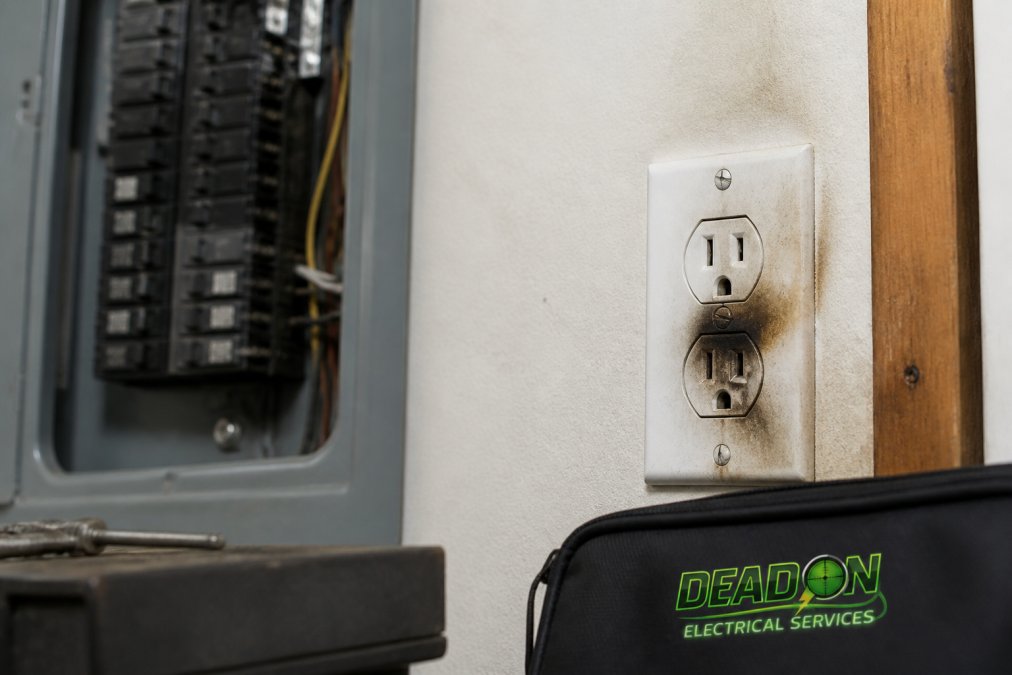
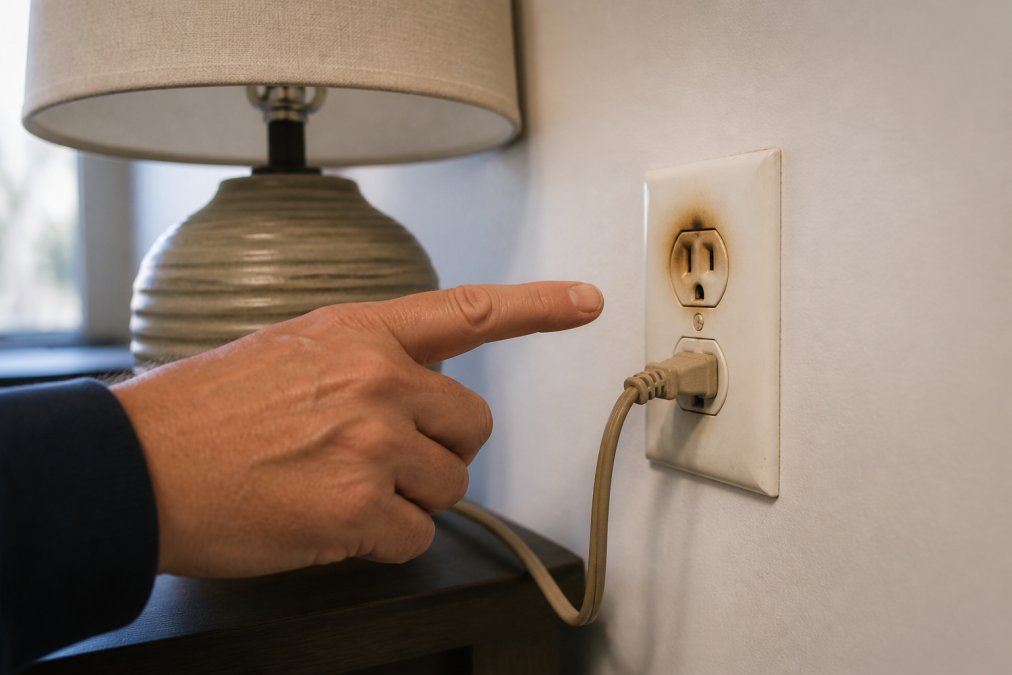
Warmth at a switch plate, a burning smell near a panel, or brown discoloration around an outlet all mean heat is building where it shouldn’t. Scorching is evidence of arcing or an overloaded connection, and it does not resolve on its own.
If you smell burning and can’t trace it to an appliance, shut off the circuit at the breaker and call an electrician. A smell with no visible source often comes from inside a junction box or the panel itself.
Outdated Wiring, Overloaded Cords, and Tripping Breakers
Two-prong outlets with no ground, cloth-insulated wire, and aluminum branch circuits are all age-related risks. Aluminum wiring in particular loosens at terminal connections over time and needs evaluation by someone who works with it regularly.
Extension cords used as permanent wiring are the other pattern we see constantly. A cord running a space heater, a window unit, or a pool pump is a code violation and a fire hazard, because cords aren’t rated for continuous load.
Why Do Breakers Keep Tripping?
Repeated breaker trips can be caused by an overloaded circuit, short circuit, ground fault, failing breaker, or another electrical problem. How and when the breaker trips helps an electrician narrow down the cause.
- Overload: too many loads on one circuit. Move devices to another circuit and see if it holds.
- Short circuit: a hot wire touching a neutral or ground. This trips instantly and needs diagnosis.
- Ground fault: current escaping to ground, often from damaged insulation or moisture. Common at outdoor and pool equipment.
- Weak breaker: a breaker that trips below its rating has failed and needs replacement.
If a breaker trips immediately every time you reset it, stop resetting it. That pattern means a short or ground fault, and repeated resets can damage the panel. Dead On Electrical Services diagnoses these with circuit-level testing rather than guesswork.
Electrical Safety Inspection Checklist for Homeowners
An electrical safety inspection checklist is a room-by-room visual review you can do yourself, followed by a professional inspection of anything you can’t see. It won’t replace a licensed electrician’s diagnostic work, but it catches problems early.
- Check every outlet and switch plate for warmth, discoloration, or cracks
- Test each GFCI outlet using its test and reset buttons
- Look for extension cords used as permanent wiring
- Confirm no cords run under rugs, through doorways, or behind baseboards
- Check that outdoor and pool equipment outlets have GFCI protection
- Look for flickering or dimming when large appliances start
- Note any breaker that trips repeatedly
- Check the panel for rust, scorching, or a burning smell
- Confirm the panel cover is secure and no breakers are taped in the “on” position
- Look for two-prong outlets or ungrounded receptacles
When to Replace an Electrical Panel
Replace an electrical panel when it can no longer safely carry the home’s electrical load, when it’s a known problem design, or when it shows heat damage. Age alone isn’t the deciding factor, but a panel that’s tripping, running warm, or full with no space for new circuits is telling you something.
Signs it’s time for an evaluation:
- The panel is full, with no open spaces for a new circuit
- Breakers trip repeatedly under normal household load
- The panel runs warm or smells hot
- You see rust, scorch marks, or corrosion inside the enclosure
- The panel is a discontinued design with known failure issues
- You’re adding a Level 2 EV charger or a dedicated 240V circuit
Adding a Level 2 EV charger is one of the most common reasons homeowners here call us about a panel. A 240V circuit for charging draws a serious continuous load, and the panel has to have both the capacity and the physical space to support it. Dead On Electrical Services handles Level 2 charger installations and dedicated 240V circuits, and we’ll tell you honestly whether your existing panel can carry the load or needs an upgrade first.
Wiring Risks by Home Age and Smart Device Load
Generic symptom lists treat every home the same. In the field, the wiring problems we find track two variables: when the home was built and how much load has been added since. A 1965 ranch with original two-wire circuits and a 2015 build with a heat pump, EV charger, and smart devices on every circuit fail in completely different ways.
What Each Build Era Tends to Have
- Pre-1950s: Knob-and-tube wiring in older pockets of the valley, often buried under added insulation. No equipment ground. Insulation that has gone brittle and crumbles when a device is pulled out of the box.
- 1950s-1960s: Two-prong ungrounded receptacles, 60-amp service in many original homes, and cloth or early rubber-insulated conductors. Small panels with no room for modern circuits.
- 1970s: Aluminum branch-circuit wiring was common during this period. Aluminum expands and contracts more than copper under load, and the terminal connections loosen over decades. It needs evaluation by someone who works with it regularly, not a generic outlet swap.
- 1980s-1990s: Copper branch circuits, but often 100-amp service and a panel that is now full. GFCI protection was not required in as many locations as it is today.
- 2000s and later: Generally modern grounding and adequate electrical capacity, but added EV chargers, pool equipment, electric appliances, or HVAC upgrades can still increase demand beyond what the original system was designed around.
In the Las Vegas Valley, attic and garage circuits run hot enough in summer to accelerate insulation aging and terminal wear. A circuit that would last decades in a milder climate can show heat damage years earlier here.
Smart Devices and Older Wiring
Smart devices themselves generally use very little electricity and usually aren’t a major load concern. The more common issue is compatibility with older wiring, especially smart switches that require a neutral conductor that may not be present in older switch boxes.
There is a second issue specific to smart switches: most require a neutral wire at the box to power the radio. Many pre-1980s homes were wired with switch loops that have no neutral in the switch box. Homeowners discover this after buying the switch. An electrician can run a neutral to the box, or recommend a no-neutral smart switch model that works with the existing wiring.
The Combination That Causes the Most Problems
The pattern we see most often is an older panel and older branch circuits carrying new high-draw loads: a Level 2 EV charger, a heat pump, a tankless water heater, or a pool pump added to a home that was never calculated for them. The panel has the physical breakers, but not the capacity, and the branch circuits were never sized for continuous load.
Insurance, Code Compliance, and DIY Repair Risks
Unpermitted or improperly performed electrical work can complicate an insurance claim, particularly when that work is related to the loss. Insurance requirements vary by company and policy, which is another reason to keep permits and inspection records for major electrical work.
How Faulty Wiring Affects Insurance
Homeowners policies generally expect the electrical system to be maintained and to meet the code in effect when work was performed. That does not mean every older home needs to be brought up to current code. It means undisclosed hazards and unpermitted work are the problems.
A common pattern after an electrical fire: the adjuster asks for the permit history on the circuit or panel involved. If the work was done without a permit, or by an unlicensed party, the claim can be delayed, partially denied, or denied outright depending on the policy language and the cause. Insurers and lenders may also ask for documentation of a panel upgrade or a new dedicated circuit before binding or renewing coverage.
A few practical points worth knowing:
- Disclose known electrical issues when applying for or renewing coverage. Non-disclosure is the bigger risk than the issue itself.
- Keep permits and inspection sign-offs for any panel upgrade, new circuit, or EV charger installation. These are the documents that get requested after a loss.
- If you are selling, an unpermitted circuit or panel change often surfaces during the buyer’s inspection and becomes a negotiation item.
What Inspectors and Adjusters Look At First
When a home inspector or insurance inspector walks a property, the electrical items that draw attention are consistent:
- GFCI protection at kitchen counters, bathrooms, garages, outdoors, and pool/spa equipment areas.
- AFCI protection on bedroom and living-area circuits in homes built or renovated under newer code cycles.
- Grounding and bonding, a proper equipment ground at receptacles, and bonding of pool and spa equipment and metal water piping.
- Panel condition, open spaces, breaker labeling, no improperly double-tapped breakers, no scorching or rust, and no breakers taped or blocked in the “on” position.
- Junction boxes, every splice enclosed in an accessible box, not buried behind drywall.
These are the items most likely to be flagged, and most of them are inexpensive to correct when caught early.
Where DIY Stops Being Reasonable
Replacing a like-for-like outlet or switch with the power off at the breaker is a reasonable homeowner task when the wiring is straightforward and the box is in good condition. Everything past that is where the risk climbs fast:
- Diagnosing a short or ground fault requires circuit-level testing. Guessing by swapping breakers or devices can mask the real fault.
- Replacing a breaker means working inside a live panel. Replacing a breaker requires removing the panel cover and working near energized service components. Even with the main breaker turned off, service conductors and line-side connections can remain energized.
- Adding a circuit, running a neutral, or installing a Level 2 EV charger involves load calculation, conductor sizing, and permit and inspection requirements.
- Any work at the panel, including tightening a terminal, should be done by a licensed electrician. A loose or over-torqued connection is a fire that starts inside the wall and may not show for months.
If you found something on the checklist that you are not certain about, the right move is to stop and have it looked at. Dead On Electrical Services is licensed and insured and works on homes across the Las Vegas Valley. If you would rather have a professional evaluate what you found, we can schedule a visit and give you a straight answer on what actually needs repair.
Frequently Asked Questions
What are the early warning signs of an electrical fire?
Watch for burning or fishy smells, outlets or switch plates that feel hot, buzzing or crackling sounds, scorch marks, and lights that flicker or dim when appliances cycle on. These point to overheating, arcing, or loose terminal connections inside a box. If you notice any of them, stop using that circuit and have a licensed electrician inspect it. Faulty electrical wiring is a leading cause of home electrical fires, so treat these signs as urgent.
How can I tell if my home’s wiring needs to be replaced?
Age and wiring condition are the biggest clues. Aluminum branch wiring, deteriorated cloth-insulated cable, ungrounded two-prong circuits, damaged insulation, repeated breaker trips, flickering lights, and hot outlets are all reasons to have the wiring evaluated. An electrician can inspect the system and determine whether individual repairs, safety upgrades, or a larger rewire are appropriate.
Why do my circuit breakers keep tripping frequently?
A breaker trips to stop an overload, a short circuit, a ground fault, or a failing breaker. If it trips only when you run the microwave and space heater together, that is an electrical load problem. If it trips with nothing unusual running, suspect damaged insulation, frayed wires, or arcing. Reset it once; if it trips again, call a licensed electrician instead of repeatedly forcing it back on.
Are flickering lights always a sign of bad wiring?
No. A single flickering bulb is often a loose bulb or a dimmer that is not compatible with LED wattage. But when lights dim every time the AC, pool pump, or dryer kicks on, or when flickering spreads across several rooms, that points to voltage fluctuation, a loose neutral, or an overloaded circuit. In our climate, heat-stressed connections in the panel and at outlets make this more common.